Showing posts with label Beginners Guide to Tarot. Show all posts

Saturday, 10 March 2018

Pisces in the Minor Arcana: The Ten of Cups

The Ten of Cups, in the astrological correspondence system I follow, is linked to Mars in Pisces, and the final third of Pisces (10th-19th March). 

First of all, what qualities does Mars bring to Pisces?  Fire and Water... Mars is assertive and determined, and takes the initiative – so in Pisces, we could be looking for assertiveness in terms of ideals or ideology. Assertive, but at the same time compassionate and kind.  The initiative and drive we associate with Mars will be softened by the sensitivity of Pisces.  Desires and dreams are achieved by following instinct, or those moments of inspiration. The shadow side of this could manifest in emotional vulnerability.
10 of Cups (trimmed):
© Crowley Thoth Tarot

And in the Ten of Cups?  I’m going to start with the Thoth deck, because – being a visual person – I like to see the astrological symbolism in the card’s image! If you look carefully at the cups, you can see that the handles are actually rams’ horns, giving us the Mars (through its rulership of Aries) connection. Gerd Ziegler writes, in his Tarot: Mirror of the Soul (published by Weber Books, 1998), Mars in Pisces provides “the apparently fragile being with the decisiveness needed to bring forth into the outer world the beauty which it holds within.”  So we have the drive of Mars, but not the drama of Aries – instead, Pisces allows those qualities to gently radiate. 

Ten of Cups (trimmed):
© Sharman-Burke/Caselli Tarot
That helps me to see the more permanent sense of contentment that we’ve come to associate with the Ten of Cups – as opposed to the moment of ‘bliss’ of the Nine.  With the Ten, we have a sense of completion – emotional fulfilment in relationships, be they romantic, familial, platonic.  To achieve and maintain this sense of fulfilment (Crowley used the word ‘satiety’ to describe this card), we need the effort and drive of Mars, allowing us to turn our dreams into reality, rather than let them stay a Piscean vision. But we still have that Piscean flow (Mutable Water) of feeling running through the card – symbolized in the Sharman-Burke/Caselli image (from the Beginners Guide to the Tarot) by the river off to the side, as well as the contentment represented by the happy family.


Ten of Vessels (trimmed):
© Wildwood Tarot
The Wildwood shows that unconstrained happiness – compare it to the Saturn in Pisces Eight of Vessels. In the Eight, the water is flowing but it’s being channelled – a structure has been imposed on the flow. In the Ten, there’s no such constraint – the water is in free-fall, splashing, overflowing...in full-on Mars flow!


Beginner’s Guide to the Tarot created by Juliet Sharman-Burke, illustrated by Giovanni Caselli, published by Connections
Thoth Tarot created by Aleister Crowley, illustrated by Lady Frieda Harris, published by U.S. Games Systems, Inc.
Wildwood Tarot created by Mark Ryan and John Matthews, illustrated by Will Worthington, published by Connections

If you’ve enjoyed this post, you might be interested in my e-book, Astrology in Tarot.


Monday, 26 February 2018

Pisces in the Minor Arcana: The Eight of Cups

In the astrological correspondence system that I follow, Pisces is linked to the Eight, Nine and Ten of Cups. Today I’m going to look at the Eight of Cups, which corresponds to Saturn in Pisces – and to the first third of Pisces (so this year, the 18th-27th February).

Pisces is the mutable Water sign, so we’re looking at our emotional resources and how these might need to change.  Saturn sets limits – something that Pisces doesn’t like! – but also helps us to maintain our integrity. Combined with Pisces, it wants to transcend the restrictions that we find ourselves surrounded by so that we can ‘merge’ with others.  It needs to find a way to express its feelings in such a way that it still feels stable – but not stuck.

Eight of Cups (trimmed):
© Sharman-Burke/Caselli Tarot
So how might this play out in the Eight of Cups?  Let’s start with a relatively ‘traditional’ depiction of the Eight of Cups – as illustrated by the Sharman-Burke/Caselli (Beginners Guide to the Tarot) deck. Here we see a figure walking away from eight cups, neatly and carefully stacked.  Despite the care taken to place the cups in this pattern, the figure is abandoning them because they no longer provide the emotional security needed.  Notice the waning moon in the sky – something is drawing to an end.  There’s no sign of any life in the landscape, so there’s no hint as to what the figure is heading towards. But ‘8’ is the number of death and birth (8th house themes, in astrology), cycles and recycling – time to let go of what’s no longer working, time to move forward to something new and (as yet) unknown (shades of the Moon card, associated with Pisces). Otherwise, stagnation looms.

Eight of Cups (trimmed):
© Thoth Tarot
Stagnation is the theme of the Eight of Cups in the Thoth deck, showing us the other side of the coin, so to speak.  Here we see standing water, unmoving, at risk of becoming stagnant without the flow of fresh water to refresh the situation.  Saturn represents the needs to set some new limits, to learn to say ‘no’, to walk away from a situation or relationship – something that’s close to the heart - that’s no longer working, despite all the time and effort that’s been put into it. Things have run their course, the well is dry; it’s time to move on. Saturn in Pisces speaks of the need to change old patterns so that we don’t become stuck in an emotional rut, or stagnate.


Eight of Vessels (trimmed):
© Wildwood Tarot
The Wildwood Tarot wasn't created with astrology in mind, but I like to look at it to see if there's any connections in the imagery.  In the Eight of Vessels we see water flowing freely - but is it? The rocks place boundaries on the water, collecting it in pools before channelling it between rocks to keep it moving! So yes, Saturn in Pisces works here...

Eight of Cups (trimmed):
© Margarete Petersen Tarot
In Margarete Petersen’s Eight of Cups, the frame around the image alone gives us a sense of structure being imposed, something being restricted.  Within the frame, an upside-down head is submerged in the deep blue sea. A stream of lighter blue emanates from it up to the surface – air rising to the surface and on up into the atmosphere (as I see it!). Again, the idea of being trapped in the depths of something that feels out of our control, yet we find a way to breathe and draw in air from beyond the barrier that holds us in this ‘hemmed-in’ state/place. And if we don’t? Indolence, or a sense of stagnation, could set in.


Beginner’s Guide to the Tarot created by Juliet Sharman-Burke, illustrated by Giovanni Caselli, published by Connections
Margarete Petersen Tarot, AGM-URANIA/Deep Books, 2004.
Thoth Tarot created by Aleister Crowley, illustrated by Lady Frieda Harris, published by U.S. Games Systems, Inc.
Wildwood Tarot created by Mark Ryan and John Matthews, illustrated by Will Worthington, published by Connections


Monday, 12 February 2018

Aquarius in the court cards

Last but not least, by any means – Aquarius in the court cards. But which one – or ones?  Different traditions have different astrological correspondences when it comes to the Court Cards.  For instance, the Hermetic Order of the Golden Dawn chose to assign cardinal attributes (initiating things) to the Queens, fixed (maintaining order) to the Kings, and mutable (being able to adapt and transform) to the Knights.  Each court card is also linked to the elements, with Pages with Earth, Knights being associated with Fire, Queens with Water, and Kings with Air. 

Prince of Swords (trimmed):
© Thoth Tarot
Following this system, we end up with Fixed Air sign Aquarius being associated with the King of Swords (Air of Air).  The Thoth deck follows this convention, of course, being rooted in the Golden Dawn tradition - although Crowley chose to use Princes rather than Kings, just to add to the confusion. In the image from the Thoth, we see the Prince of Swords slaying whatever stands in his way. Fast but also careful, he’s discriminating in what he chooses to remove in order to create something new and innovative. 


Queen of Swords (trimmed):
© Sharman-Burke/Caselli Tarot
If you work with a system that assigns the Fixed mode to the Queens, you’re looking at the Queen of Swords.  An example of this is the Sharman-Burke/Caselli tarot (Beginners Guide to the Tarot). Here we see the Queen on her throne, which is decorated with butterflies (symbolizing the element of Air) and an eagle’s head (the form that Zeus took in order to transport Ganymede to Mount Olympus to become the cup-bearer of the gods, taking his place in the sky as Aquarius).  The single bird in the clear sky, above the storm clouds on the horizon, represents clarity; this queen can see past obstacles and keep her mind on the objective.  The upright sword represents justice and equality – high ideals – and all strong Aquarian qualities.  Detachment, another Aquarian quality, allows the Queen of Swords to remain dignified even though she’s known loss and pain – she won’t wear her heart on her sleeve, but bears sorrow with fortitude and courage. 


Beginner’s Guide to the Tarot created by Juliet Sharman-Burke, illustrated by Giovanni Caselli, published by Connections
Thoth Tarot created by Aleister Crowley, illustrated by Lady Frieda Harris, published by U.S. Games Systems, Inc.


Thursday, 8 February 2018

Aquarius in the Minor Arcana: The Seven of Swords

The Seven of Swords, in the astrological correspondence system I follow, is linked to the Moon in Aquarius - as well as to the final ten days of Aquarius (10th-19th February this year).   We’re still looking at Fixed Air, but now we add some water through Cancer’s rulership of the Moon.  

So if this is the sign of the unconventional and the unorthodox, the reformer and revolutionary, how is it affected by the Moon?  Well, the Moon is about emotional needs and about the way we react to things automatically, instinctively.  So an Aquarian Moon could react unpredictably, perhaps, and with a sense of detachment.  Being free to express ideas, especially ones that don’t conform to the ‘norm’, and to be innovative might give this Moon a sense of security.

Seven of Swords (trimmed):
© Sharman-Burke/Caselli Tarot
But how does this fit with the Seven of Swords? This card is often linked to being stealthy – one of my tarot friends, Alison Cross, calls it the ‘Sneaky Pete’ card.  Some say it’s about making a sly escape, but I like Juliet Sharman-Burke’s description – “tact rather than aggression”.  There’s something about thinking things through and making plans for the future (Aquarius) but taking great care with those plans. Remember the Moon is ruled by Cancer, so there’s likely to be an element of protectiveness involved – possibly to the point of being underhanded.  Aquarius brings the detachment, the clarity of vision, so that any protectiveness or nurturing quality to the action is not going be based on emotional needs.  We often warn against being too free and open about what we intend to do when we see this card – that’s the Moon’s caution acting on an Aquarian desire to spread knowledge within the community.

Seven of Swords (trimmed):
© Shadowscapes Tarot
The Shadowscapes Tarot shows us that stealthiness by a figure hiding behind a mask, having just managed to steal a sword from the swan that guards them. He thinks he hasn’t been seen but in fact the swan has one eye open and knows exactly what’s going on.  Here we can see the Moon in the idea of deception (the Moon card in the tarot is about illusion and deception, among other things).  A life lived in stealth and in deception suggests a lack of faith in the world, and that this is the only way to get what you need.  Which brings us to negative thoughts...


Seven of Swords (trimmed):
© Thoth Tarot
In the Thoth Tarot, the word that Crowley chose for the card is ‘futility’ – a daunting card to be faced with, I often feel.  As with many of the cards in this deck, I feel it’s coming from the other direction – but yet still brings us to the same point (oh, sorry – no pun intended!).  The six smaller swords each bear a glyph on their hilts, representing six of the planets.  Each of those smaller swords is meant to represent thoughts which stand in our way – negative thoughts. For instance, Mars could symbolize feeling too tired, or that there’s not enough time – while Neptune could reflect a sense of not really knowing what you want, that it’s all an illusion. Meanwhile, the Sun and Moon – the conscious and unconscious – are at opposite ends of the seventh and largest sword; the Sun glyph on its hilt, pointing towards the Moon at the top of the card. The message? Not to let a sense of it all being ‘futile’ stand in your way – by doing so, you’re actually trying to escape taking responsibility for your actions – hence the stealthy appearance of the guy in the more traditional images!


Beginner’s Guide to the Tarot created by Juliet Sharman-Burke, illustrated by Giovanni Caselli, published by Connections
Shadowscapes Tarot created by Stephanie Pui-Mun Law and Barbara Moore, published by Llewellyn
Thoth Tarot created by Aleister Crowley, illustrated by Lady Frieda Harris, published by U.S. Games Systems, Inc.


Wednesday, 24 January 2018

Hope - Aquarius in the Major Arcana

Ganymede
As usual, let’s start our exploration of Aquarius in the tarot with the Major Arcana. We already know (see the previous entry!) that it combines the element of air with fixed energy, making it a very ‘in your head’ sign.   It’s associated with ideology and reform, humanitarianism and working with community and groups.  In Greek mythology, Ganymede was the cup-bearer to the gods, serving them with the nectar or ambrosia which gave them immortality – and was placed in the heavens as the constellation Aquarius as his reward.  The contents of that cup were life-sustaining – and what is it that sustains us, more often than not? Hope. And what card in the Major Arcana could we connect with hope? The Star!

The Star (trimmed):
© Sharman-Burke/Caselli Tarot
Traditional depictions of The Star show us a young, naked woman with two pitchers of water – a water carrier.  Her youth is said to symbolize renewal, while her nakedness represents truth for all to see.  In the Sharman-Burke/Caselli Beginners Guide to the Tarot, she has one foot on land (past) and the other in water (the future), linking the two - and perhaps also linking the conscious and unconscious.  The foot in water also links us to the Pool of Memory, allowing us to remember events that give us hope, that sustain us.  Her two water jugs sustain both the land and the pool. See too how the water on the land separates into five streams, symbolizing our five senses, before returning to the pool.  Aquarius may be detached, but it can certainly feed us, providing us with hope and optimism – the promise of a new day (dawn).  The card carries the number 17, 1 + 7: there is one large star in the dawn sky, surrounded by seven smaller ones, adding up to eight, the number of re-birth and regeneration – more promise of hope. 

XVII The Star (trimmed):
© Shadowsacpes Tarot
The Shadowscapes Tarot gives us a more ethereal figure. She's not a water carrier in the strictest sense of the word, although both water and air (remember we're talking about Aquarius here) are present in the image - her feet dance in water while the rest of her dances in the air against a backdrop of the Milky Way, representing perhaps the fixedness of this sign (yes, there are some stars that are referred to as 'fixed'!).  According to the creator, in the accompanying Shadowscapes Companion (see details below), "she dances the dance that the stars have choreographed...their silent homage to the burning spirit they have witnessed." So although in reality stars shine with their own light, you could say these ones are reflecting the hope that each person carries!

17 The Star (trimmed):
© SWildwood Tarot
Sailors used to – and perhaps some still do – navigate by the stars at night. Polaris is one of the (apparently) ‘fixed’ stars in the northern sky, making it particularly useful in celestial navigation – and therefore a symbol of hope in its own right.   In the Wildwood Tarot, the Pole Star is referred to as a symbol of “universal law, spiritual knowledge and power”. What brings it back to the traditional meaning of the Star, for me, is the idea of universal knowledge being a web – a very Aquarian concept! 

XVII The Star (trimmed):
© Thoth Tarot
The Thoth uses the Egyptian sky goddess Nuit (also known as Nu, Nut, and Nuith) to depict the water carrier.  Here we get more of a sense of the ideological aspects of Aquarius – Nuit receives inspiration from the universe and allows it to flow through her, passing it on to humanity, or the greater good.  The card represents clarity of vision, which we could associate with the ‘airiness’ of Aquarius, while Nuit appears to be grounded, representing the ‘fixedness’ of the sign.


No surprise that Imbolc occurs during our sojourn in Aquarius – first signs of spring bringing forth hope. The Imbolc Tarot Blog Hop takes place on 31st January – watch this space!


If you’ve enjoyed this post, you might be interested in my e-book, Astrology in Tarot, now available from Amazon.


Beginner’s Guide to the Tarot created by Juliet Sharman-Burke, illustrated by Giovanni Caselli, published by Connections
Shadowscapes Tarot created by Stephanie Pui-Mun Law and Barbara Moore, published by Llewellyn
Thoth Tarot created by Aleister Crowley, illustrated by Lady Frieda Harris, published by U.S. Games Systems, Inc.
Wildwood Tarot created by Mark Ryan and John Matthews, illustrated by Will Worthington, published by Connections


Thursday, 18 January 2018

Capricorn in the court cards

Now let’s look at Capricorn in the court cards. But which one – or ones?  For instance, the Hermetic Order of the Golden Dawn chose to assign cardinal attributes (initiating things) to the Queens, fixed (maintaining order) to the Kings, and mutable (being able to adapt and transform) to the Knights.  Each court card is also linked to the elements, with Pages with Earth, Knights being associated with Fire, Queens with Water, and Kings with Air. 

Queen of Pentacles (trimmed):
© Universal Waite Tarot
Following this system, we end up with Cardinal Earth sign Capricorn being associated with the Queen of Pentacles (Water of Earth). What qualities do we associate with this Queen? Pragmatic, well-organized, good with finances, a loyal friend who’s always ready to listen and dispense practical advice.  As well as finances and possessions, she also represents taking care of – and taking pleasure in – the body.  We also associate her with caring for the earth – and enjoying its wealth.

Plenty of goat imagery in the Universal Waite's Queen of Pentacles! We also see plenty of symbolism around nature, a connection to the land, and the enjoyment of its riches.

Queen of Disks (trimmed):
© Thoth Tarot
The Crowley Thoth’s Queen of Disks is one of my favourite representations of this card. We see her resting in a green and fertile oasis, looking back over the barren, difficult landscape that she’s had to travel through to reach this point. The goat looks at us, rather cheekily, I always think – as if to say “see? We made it!” – reminding us of the tenaciousness and independence of the mountain goat as he surmounts obstacles in his way. We see this too in the curved horns on the Queen’s headdress.  Remember too, what we said about the goat when we looked at the Devil – that it also represents procreation and new life.  This Queen knows what she needs in order to nourish herself – and others – and has worked hard to achieve it. Now she can rest and enjoy the fruits of her labours.


King of Pentacles (trimmed):
© Sharman-Burke/Caselli Tarot
If you work with a system that assigns cardinality to the Kings, you’re looking at the King of Swords.  In the image from Juliet Sharman-Burke’s Beginners’ Guide to the Tarot, we see the King on his throne, adorned with carvings of goats’ heads, symbolizing Capricorn and the steady, determined hard work that’s helped him to realize his ambition. Behind him we see his castle and grounds – symbols of his achievement, both in terms of material success but also of his status in society. They also appear to be on top of a mountain, reminding me of the sure-footed-ness of the mountain goat as he picks his way around obstacles in his way to the top. Security and stability have been gained through effort and sheer determination, and the King is now in a position to share this wisely and generously.


If you’ve enjoyed this post, you might be interested in my e-book, Astrology in Tarot, now available from Amazon.


Beginner’s Guide to the Tarot created by Juliet Sharman-Burke, illustrated by Giovanni Caselli, published by Connections
Thoth Tarot created by Aleister Crowley, illustrated by Lady Frieda Harris, published by U.S. Games Systems, Inc.
Universal Waite Tarot created by Mary Hanson-Roberts & Pamela Colman-Smith, published by U.S. Games Systems, Inc.


Friday, 12 January 2018

Capricorn in the Minor Arcana: The Four of Pentacles

Moving on from the Three of Pentacles and that sense of initial completion – the result of patient, disciplines planning – we come to the Four.  We’ve progressed from the expansiveness and benevolence of Jupiter, in the Two, through the determination and drive of Mars in the Three, into the power of the Sun – all in Capricorn. 

Four of Pentacles (trimmed):
© Sharman-Burke/Caselli Tarot
The Sun in Capricorn conjures up a sense of creative energy being “coloured” by discipline and tradition – a single-mindedness, perhaps, working towards a well-defined target. Whatever that target or goal is, it’s going to be about being able to express ourselves and our creativity, but in a responsible way. On the downside, pessimism and cynicism can stand in the way of progress.  We might also find ourselves overly concerned with ‘how things look’, or wanting to hold on to what we have.  Either way, the Sun in Capricorn can represent a strong commitment to the material things in life – be they possessions and/or resources.


Four of Disks (trimmed):
© Thoth Tarot
We see this in the Four of Pentacles, which often symbolizes a fear of letting go, especially in terms of material things.  We may need to be reminded that although nothing is lost if we hold on to what we have, we may not gain anything either – we run the risk of stifling the flow of energy, instead of letting things run their natural course. The expansion that Jupiter promised in the Two could be hindered through our fear of ‘what might happen’ – the ‘what ifs’.


In the Thoth Tarot, the word that Crowley chose for the card is ‘Power’ – the strength of the Sun in a strong, steady, determined Earth sign. It’s grounded. Just look at the image – a fortress, firmly anchored in four corners. Squares are solid, stable, powerful structures; it’s hard to move them, so there’s a sense of protection here, but also of rigidity. The solidity of the structure reflects our own integrity, but also reminds us of the danger of inflexibility and the inability to compromise.

Four of Coins (trimmed):
© Margarete Petersen Tarot
In Margarete Petersen’s Four of Coins cards we also see the square-bounded enclosure, reminiscent of the Crowley version: providing structure, or (on the shadow side) boxing us in.  

The serpent (seen in both the Thoth's and Petersen's Two of Disks) is back, too, forming a complete enclosed area too - an ouroboros, constantly re-creating itself. The solidity of the structure and the strength of the ouroboros reflect our own integrity, but we have to remember the danger of inflexibility and the inability to compromise.  Nothing ventured, nothing gained!

Treasure held safely
within strong walls - but is it
still accessible?


The Four of Pentacles is also linked to the final ten days of Capricorn – from the 10th of January to the early hours of the 20th, when we move into Aquarius...


Beginner’s Guide to the Tarot created by Juliet Sharman-Burke, illustrated by Giovanni Caselli, published by Connections
Margarete Petersen Tarot, AGM-URANIA/Deep Books, 2004.
Thoth Tarot created by Aleister Crowley, illustrated by Lady Frieda Harris, published by U.S. Games Systems, Inc.


Monday, 1 January 2018

Capricorn in the Major Arcana – The Devil!

Happy New Year!

Carrying on with our exploration of Capricorn, we come now to The Devil – but why? What’s the link between the two?

XV Cernunnos (trimmed):
© Druid Craft Tarot
Well, goats have come to symbolize sexuality in many mythologies – for instance, Pan, the Greek goat-god, who was linked to the idea of ‘wild desire’.  In northern European traditions, we have the Horned God, or the Celtic Cernunnos, representing nature and sensuality. Throughout the ages, though, the goat has also become almost synonymous with the Devil, supposedly representing temptation and giving in to our desires.   With Capricorn being an Earth sign, the references to sensuality and physical desire can be extended to material desires. So when we come across the Devil in the tarot, we’re reminded about what’s overpowering or obsessive, the things we try to suppress or deny. It can represent not only temptation, but also surrender – and reminds us that we have the power within us to keep our feet on the ground! 

XV The Devil (trimmed):
© Haindl Tarot
Hermann Haindl’s depiction of the Devil shows both a goat, the traditional Capricorn image, and a serpent. Rachel Pollack, in her Haindl Tarot: A Reader’s Handbook (published by Llewellyn, 2005), talks about kundalini energy being raised by both creatures, through the spirals of the goat’s horns and the coils of the serpent. 

XV The Devil (trimmed):
© Thoth Tarot
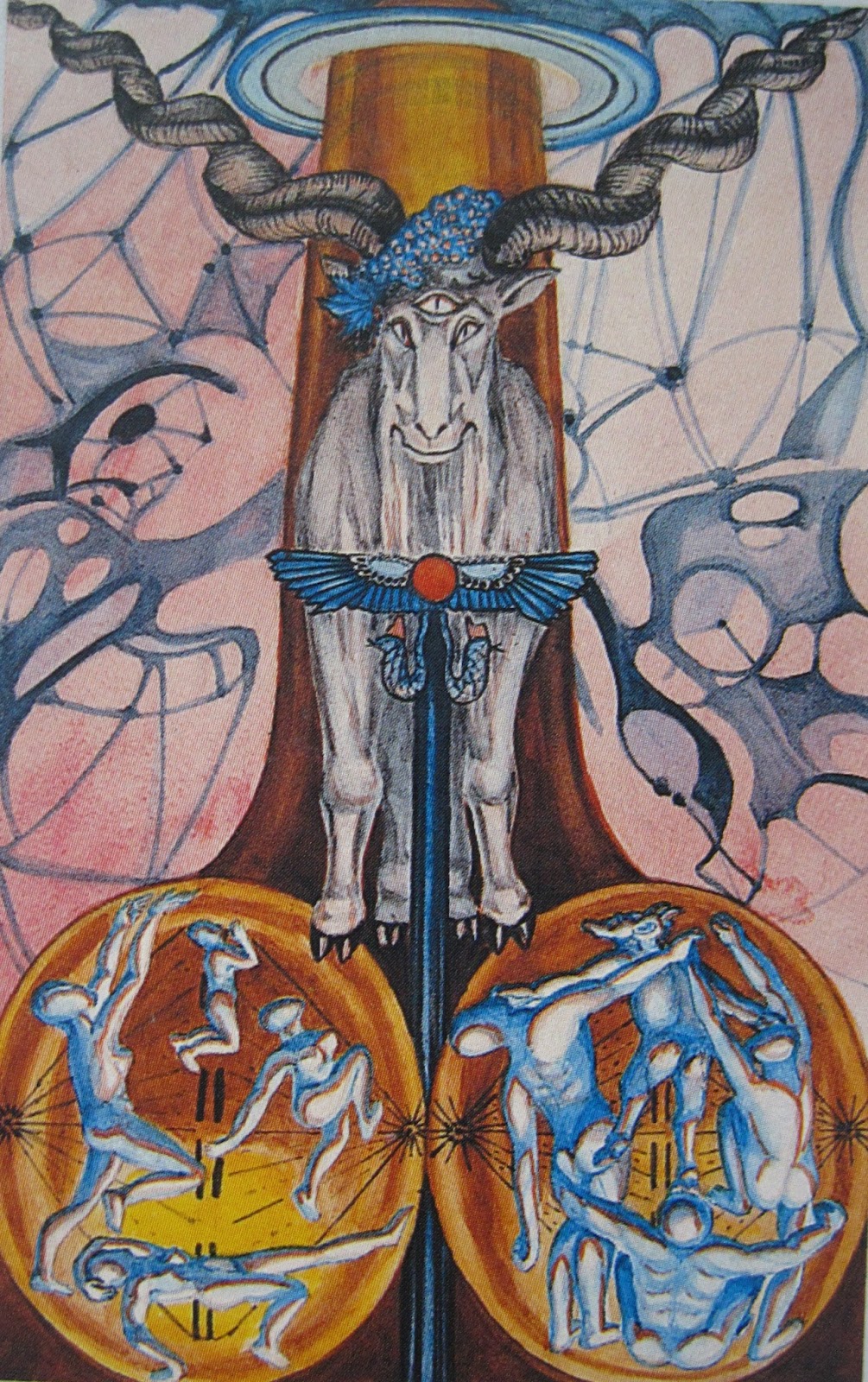
The Devil in Crowley’s Thoth deck always makes me laugh – who can resist that wicked grin of that goat?!  Laughing at how we become imprisoned by our desires and obsessions...and those twisted horns remind me of the twisted sense of humour... There’s an emphasis here on the procreative energy, too, with a very obvious phallic symbol taking centre-stage.


The Devil (trimmed):
© Sharman-Burke/Caselli Tarot
These images are quite different from the more traditional depictions of The Devil, yet the messages are similar. Juliet Sharman-Burke talks about “power and energy imprisoned”, the Devil-goat in the image symbolizing the material world, to which the figures have voluntarily chained themselves – there are chains around their necks but those chains aren’t right, and the figures’ hands are not restricted at all.  I see Saturn, the ruler of Capricorn, coming into play here – those figures show no indication of wanting to make any change, to escape the restrictions they’ve placed on themselves.  Sharman-Burke goes on to say “The Devil refers to all that is dark within your own psyche. That is why we like to think of The Devil’s abode as deep within the bowels of the earth in a place so safely removed from us that we do not have to deal with him. However, such an attitude also means that we live in fear of The Devil, and remain chained to his block of inhibition, restricted because we cannot face the truth about ourselves.”  (The Beginner’s Guide to the Tarot, Juliet Sharman-Burke, Connections 2001)

XV The Devil (trimmed):
© Shadowscapes Tarot
In the Shadowscapes deck, Stephanie Pui-Mun Law gives us a much more ethereal view of The Devil, but we still see that figure seemingly imprisoned – yet not allowing herself to see that there’s an obvious way out. Rather than choose to see the beauty around her, she hides her eyes – what is it she’s so afraid of? The Devil dances above her, laughing at how easy it is to keep what should be a vibrant creature a prisoner – a prisoner of her own fears.


So The Devil acts as a reminder to free ourselves of those restrictions we placed on ourselves and surrender to earthy sensuality (which, as a double Taurus, I shouldn’t have any problems with!) and to meet those who would ‘demonize’ us and what we believe in with humour!


If you’ve enjoyed this post, you might be interested in my e-book, Astrology in Tarot, now available from Amazon.


Beginner’s Guide to the Tarot created by Juliet Sharman-Burke, illustrated by Giovanni Caselli, published by Connections
Druid Craft Tarot created by Philip Carr-Gomm and Stephanie Carr-Gomm, illustrated by Will Worthington, published by Connections
Haindl Tarot, created by Hermann Haindl, published by U.S. Games Systems, Inc.
Shadowscapes Tarot created by Stephanie Pui-Mun Law and Barbara Moore, published by Llewellyn
Thoth Tarot created by Aleister Crowley, illustrated by Lady Frieda Harris, published by U.S. Games Systems, Inc.


Sunday, 17 December 2017

Sagittarius in the court cards: quest for fire!

Last but not least, by any means – Sagittarius in the court cards. But which one – or ones?  Different traditions have different astrological correspondences when it comes to the Court Cards.  In the system I follow, correspondences depend on how cardinality, fixity and mutability have been assigned.  As Sagittarius is the mutable Fire sign, this gives us the Knight of Wands.

Knight of Wands (trimmed):
© Sharman-Burke/Caselli Tarot
In the Sharman-Burke/Caselli deck (Beginners Guide to the Tarot) we see the Knight charging towards us on a horse that looks as though it’s flying through the air.  Fire is represented by the arid background, the sun motif on the Knight’s cloak, and the salamander motif on the horse’s trappings.  The mutability is in the action, but also in the pyramids, representing old knowledge or wisdom. The Knight has visited that location, and is now taking that knowledge with him, intending to spread it on his adventures – transforming, bringing change.   

Like all the knights, he’s on a quest for knowledge, which is in itself quite Sagittarian – but this one is primed for action and adventure!  The fact that he’s so confident and positive works for him; he doesn’t consider the possibility that he might fail in his quest, an attitude which often leads to successful outcomes. 

Knight of Wands (trimmed):
© Shadowscapes Tarot
In the Shadowscapes deck, the Knight rides on a lion, not a horse. The lion symbolizes the strength of his feelings, his determination and passion (courage=coeur+rage? a stretch perhaps…!) as he heads out on his quest.  The foxes represent cleverness - the ability to think quickly, on his feet - while the flowers that are being trampled underfoot, unnoticed by the Knight, the lion, or the foxes, act as a reminder of the shadow side of this Knight: what might be missed through being over-confident or fool-hardy.
Knight of Wands (trimmed):
© Crowley Thoth Tarot


The Crowley Thoth tarot’s Knight of Wands is also depicted as a fiery image, full of movement.  He holds the burning torch from the Ace of Wands in his left (the creative side) hand, lighting the way forward.  Sagittarian qualities – the dynamism, the quest for knowledge, the bringer of change, the disseminator of wisdom and experiences – are clearly at work! He’s impetuous, but also carries Jupiterian courage, passion, and generosity of spirit out into the world.


Beginner’s Guide to the Tarot created by Juliet Sharman-Burke, illustrated by Giovanni Caselli, published by Connections
Shadowscapes Tarot created by Stephanie Pui-Mun Law and Barbara Moore, published by Llewellyn
Thoth Tarot created by Aleister Crowley, illustrated by Lady Frieda Harris, published by U.S. Games Systems, Inc.


Sunday, 26 November 2017

Sagittarius in the Major Arcana (part 1): Temperance

Let’s start our exploration of Sagittarius in the tarot with the Major Arcana.  In astrology, Sagittarius is the last of the three Fire signs that we encounter as we go around the zodiac – the first being Aries, the second Leo.   It’s the mutable one – taking what’s been established in Scorpio and transforming it into something else.  It combines fiery passion and creativity with the expansiveness and benevolence of Jupiter, its ruler, to give us the visionary, the explorer, the philosopher. 

Temperance (trimmed):
© Sharman-Burke Caselli Tarot
The key word for me here is ‘transforming’ – that ability to take what we have and change it, to temper it... ah, you’ll see where I’m going with this now!  In the astrological correspondence system for the tarot that I follow, the Major Arcana card associated with Sagittarius is Temperance.  It’s THE alchemical card, for me – all those symbols of alchemy present in most depictions of the card. In the Rider-Waite-Smith tarot we see an angel pouring liquid from one cup to the other.  An angel also appears in the Sharman-Burke/Caselli version (Beginners Guide to Tarot); here the alchemy is emphasized by the colours of the cups – gold and silver.  There’s a need for flow between the conscious and unconscious, indicated by the flow between left and right hands, as well as one foot being on land and one in water. The rainbow symbolizes promise, as does the sun.  So, transformation gives us the link to the mutable nature of Sagittarius, but what about the Fire?

XIV Art(trimmed):
© Thoth Tarot
Well, fire plays an essential part in alchemy – some of the main alchemical processes take place in a furnace.  The Crowley Thoth tarot’s version of Temperance, entitled ‘Art’, depicts the alchemical union of fire and water.  We see here the lion and eagle, representing the Fixed signs of Leo (Fire) and Scorpio (Water), on either side of the cauldron, balancing each other.  While water can extinguish fire, it can also join together with fire to form steam – which we see rising through the centre of the card, forming two rainbows enveloping the woman’s shoulders. Again, that symbol of hope and promise – which is part of the Sagittarian’s vision. 

This symbolism also appears in the Druid Craft Tarot’s Fferyllt, the Druid alchemist.

XIV The Fferyllt (trimmed):
© Druid Craft Tarot
(The actual alchemical process associated with Sagittarius is that of ceration – the softening of hard material, achieved by continuously adding a liquid to a hard, dry substance while it’s being heated, ending up with something the consistency of molten wax.  That’s a simplification, of course... and there are a number of different definitions.)

Margarete Petersen calls this card 'Mediatrix' in her deck, reflecting the idea of moderating but in more of a mediating way. Mediation is a form of tempering, bringing together opposing sides and trying to find a more 'tempered' solution. In the image both light and dark are represented - the light and warmth of the sun, the cold and dark of the unknown/universe, separated by Iris' rainbow.

Mediatrix (trimmed):
© Margarete Petersen Tarot


Alchemist angel
Carefully measures, tempers,
From lead produce gold.


So then, Temperance – or Art, if you will – is about uniting, integrating, blending, bringing things into balance and harmony, drawing on Sagittarius’ mutability and, if you think of this as an alchemical process, on fieriness! 

If you’ve enjoyed this post, you might be interested in my e-book, Astrology in Tarot, now available from Amazon.


Beginner’s Guide to the Tarot created by Juliet Sharman-Burke, illustrated by Giovanni Caselli, published by Connections
DruidCraft Tarot created by Philip Carr-Gomm and Stephanie Carr-Gomm, illustrated by Will Worthington, published by Connections
Margarete Petersen Tarot, AGM-URANIA/Deep Books, 2004.
Thoth Tarot created by Aleister Crowley, illustrated by Lady Frieda Harris, published by U.S. Games Systems, Inc.