Friday, 19 February 2016

Going with the Pisces flow


Today at 5.33 GMT, the Sun moved (in the Tropical System of astrology) into the zodiac sign of Pisces.  The twelfth sign of the zodiac spans 330°-360° of celestial longitude, although strictly speaking this region of the zodiac is now covered mostly by the constellation of Aquarius, due to the precession from the point when both the constellation and sign of Pisces coincided*.  

In the northern hemisphere, at mid-latitudes, it’s the time of year when the ice and snow starts to melt.  Water begins to flow as it’s released from its frozen, crystalline (Aquarian!) state. Boundaries melt. It’s a time of release, of letting go, of merging. A time to learn to accept what can’t be changed or controlled, as well as a time to surrender to change that is beyond our control.
   
Unsurprisingly, then, we find that the sign of Pisces is one of the three Water signs. We’ve already met Cancer, the cardinal Water sign, and Scorpio, the fixed Water sign. Pisces – the mutable Water sign - completes the triplicity. In many ways, I think this is the easiest of the three triplicities to understand – after all, water in its natural state is free-flowing, and can be found in many forms (mutable meaning the ability to transform).

Image from Atlas Coelestis
The astrological glyph for Pisces is said to symbolize two fish held together by a string. In the constellation, the fish are usually ‘seen’ as swimming away from each other.  Alpha Piscium, the star at the point corresponding to the knot in the cord joining the two fish, is also known as Alrescha, from the Arabic al-Risa – the “well-rope” or “the cord”. The glyph’s symbolism can be extended to represent our dual nature - one fish could be seen as swimming upwards towards the heavens as if looking for spiritual guidance, while the other continues along the path of the Sun (the elliptic), concentrating on more earthly or material pursuits.

In Greek mythology, Pisces has many associations with Aphrodite (Venus in the Roman pantheon), who - as a reward to the fish who rescued her - placed the fish into the night sky. In astrological terms, Venus (the planet) is said to be exalted in Pisces, expressing all-encompassing love and compassion.

'Pisces' panel on my Zodiad dodecahedron (mixed media):
© Alison Coals
The traditional ruler of Pisces is the planet Jupiter.  Jupiter, as you may remember, is a huge planet comprised mainly of hot gas. Known as the ‘Greater Benefic’ (Venus being the ‘Lesser Benefic’), Jupiter is associated with growth, expansiveness, benevolence and laughter (Jove, the Roman version of Jupiter giving rise to the word ‘jovial’).  It’s also linked to higher learning, to philosophy, law, and religion (in the broadest sense of the word) – to expanding our horizons, lifting us to new heights (remember that hot-air balloon?!). With Pisces, it’s expressed by living through our ideals, by being compassionate and sensitive, and by developing faith in the universe as well as the self.  William Blake wrote, in his The Marriage of Heaven and Hell, that “The road of excess leads to the palace of wisdom" – a wonderful description of Jupiter in Pisces! 

'Alchemical @Pisces' ©Alison Coals
Pisces also has a modern ruler, Neptune.  This planet was ‘discovered’ (or identified!) in 1846, and was named after the Roman god of the sea.  Neptune is associated astrologically with compassion and empathy, and is said to show us the areas in our lives where we want to merge, rather than stand out. It’s linked to dreams and visions, and our highest ideals. Imaginative, but not a lover of boundaries – it wants to transcend limits.

So, where does Pisces fit into the tarot?  Stay tuned for an exploration of the final zodiac sign in the cards...

*In Sidereal astrology, the sun currently transits Pisces from approximately 15th March to 14th April.

Monday, 15 February 2016

Aquarius in the Druidcraft court cards


Today I’ll finish off our exploration of Aquarius in the tarot by looking at the court cards. But which one – or ones?   

Different traditions have different astrological correspondences when it comes to the courts.  Generally  (but not always!) these correspondences depend on how cardinality, fixity and mutability have been assigned.  

For instance, the Book-T system (www.tarot.org.il/Library/Mathers/Book-T.html) attributes the cardinal attributes (initiating things) to the Queens, fixed (maintaining order) to the Kings, and mutable (being able to adapt and transform) to the Knights.  Each court card is also linked to the elements, with Pages with Earth, Knights being associated with Fire, Queens with Water, and Kings with Air.


Other decks follow a different convention. They keep the Knights as carriers of mutable qualities, but have the Queens taking on the ‘fixed’ attributes and the Kings the ‘cardinal’ ones. 


As Aquarius is the fixed Air sign, I’m looking for the Swords court card that’s associated with ‘fixed’-ness.
 
Queen of Swords (trimmed): DruidCraft Tarot
So far in my exploration of the DruidCraft, I’ve found that the Queens seem to correspond best to the ‘fixed’ signs, so let’s look at the Queen of Wands as the Aquarian card.  That combination of air and fixed-ness suggests thoughtful humanitarian detachment.  Actually I can see that in both the King and the Queen, and unlike the other Kings and Queens, there’s no helpful symbolism in the image (that I can see) to help make my choice! It’s what Philip and Stephanie Carr-Gomm have written about the Queen that makes me see her as the Aquarian figure – “a natural analyst...discriminating and perceptive, with high ideals...ability to be detached and objective”.  


Druidcraft Tarot created by Philip Carr-Gomm and Stephanie Carr-Gomm, illustrated by Will Worthington, published by Connections 2004

Thursday, 11 February 2016

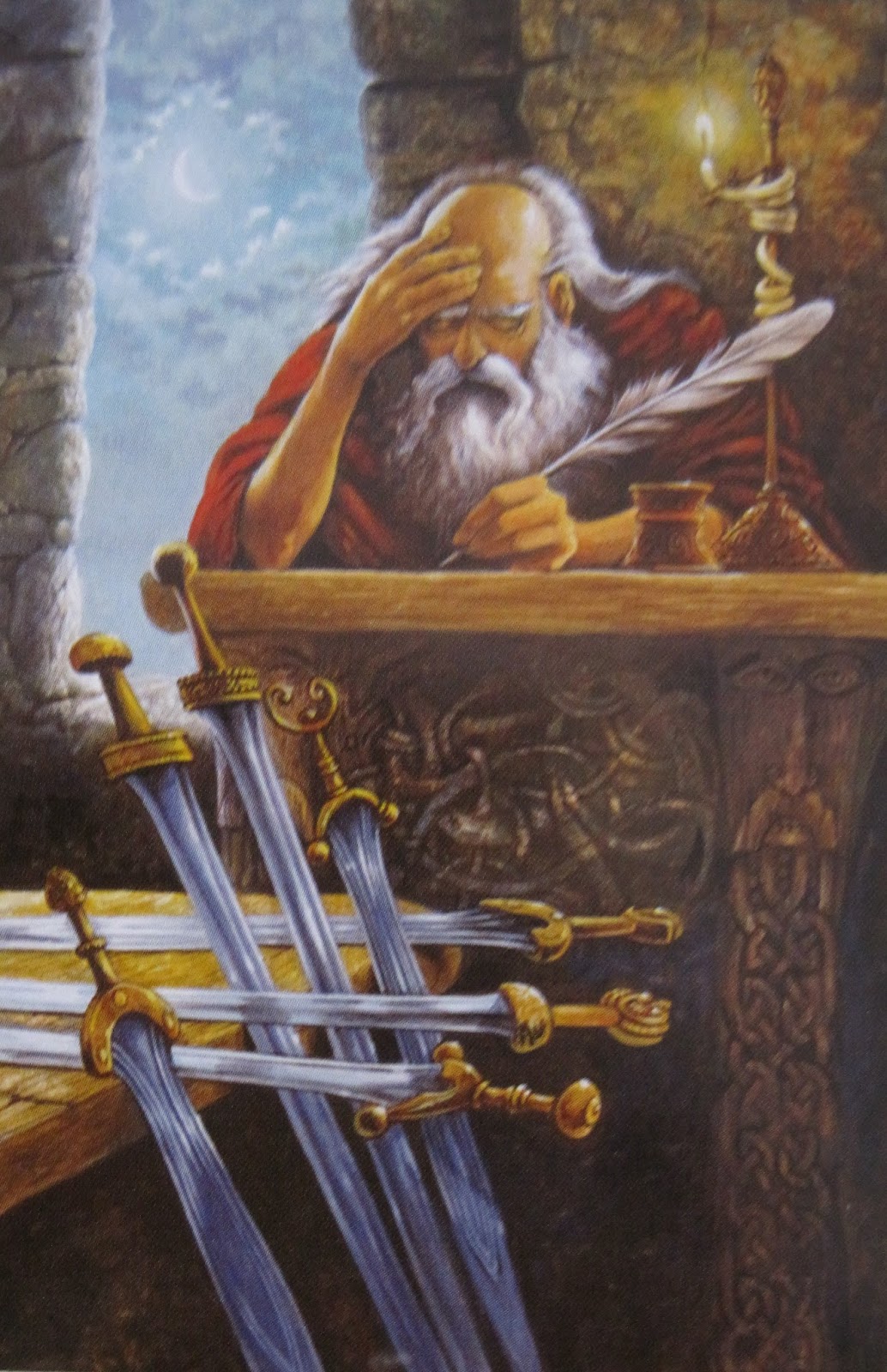
Aquarius in the DruidCraft Minor Arcana: The Seven of Swords


The Seven of Swords, in the astrological correspondence system I follow, is linked to the Moon in Aquarius - as well as to the final ten days of Aquarius (9th/10th-18th February this year).   We’re still looking at Fixed Air, but now we add some water through Cancer’s rulership of the Moon.  


So if this is the sign of the unconventional and the unorthodox, the reformer and revolutionary, how is it affected by the Moon?  Well, the Moon is about emotional needs and about the way we react to things automatically, instinctively.  So an Aquarian Moon could react unpredictably, perhaps, and with a sense of detachment.  Being free to express ideas, especially ones that don’t conform to the ‘norm’, and to be innovative might give this Moon a sense of security.


But how does this fit with the Seven of Swords? This card is often linked to being stealthy – one of my tarot friends, Alison Cross, calls it the ‘Sneaky Pete’ card.  Some say it’s about making a sly escape, but I like Juliet Sharman-Burke’s description – “tact rather than aggression”.  There’s something about thinking things through and making plans for the future (Aquarius) but taking great care with those plans. Remember the Moon is ruled by Cancer, so there’s likely to be an element of protectiveness involved – possibly to the point of being underhanded.  Aquarius brings the detachment, the clarity of vision, so that any protectiveness or nurturing quality to the action is not going be based on emotional needs.  We often warn against being too free and open about what we intend to do when we see this card – that’s the Moon’s caution acting on an Aquarian desire to spread knowledge within the community.
 
Seven of Swords (trimmed):
DruidCraft Tarot


But can we see this at work in the DruidCraft, a deck not designed with astrology in mind?  I can see the Aquarian at work here, the person working with ideas, with words, with concepts – and the man in the image looks as though he’s taking great pains with his plans.  The stealthiness is less obvious, I think, but the deck’s creators, Philip and Stephanie Carr-Gomm, write about the potential need to meet a challenge with cunning and manipulation, as well as being bold and daring – the more Aquarian approach - in the accompanying book.  The Moon representing the creation of illusion through cunning, perhaps, shining through the window?


The authors also write about another interpretation: “new ideas challenge old assumptions, insights and fresh ideas spring up, and great progress is made”.  I love the use of the word “spring” here – in the northern hemisphere, at least, the first stirrings of spring fall in Aquarius!  


DruidCraft Tarot created by Philip Carr-Gomm and Stephanie Carr-Gomm, illustrated by Will Worthington, published by Connections 2004