Showing posts with label Fixed Air. Show all posts

Thursday, 8 February 2018

Aquarius in the Minor Arcana: The Seven of Swords

The Seven of Swords, in the astrological correspondence system I follow, is linked to the Moon in Aquarius - as well as to the final ten days of Aquarius (10th-19th February this year).   We’re still looking at Fixed Air, but now we add some water through Cancer’s rulership of the Moon.  

So if this is the sign of the unconventional and the unorthodox, the reformer and revolutionary, how is it affected by the Moon?  Well, the Moon is about emotional needs and about the way we react to things automatically, instinctively.  So an Aquarian Moon could react unpredictably, perhaps, and with a sense of detachment.  Being free to express ideas, especially ones that don’t conform to the ‘norm’, and to be innovative might give this Moon a sense of security.

Seven of Swords (trimmed):
© Sharman-Burke/Caselli Tarot
But how does this fit with the Seven of Swords? This card is often linked to being stealthy – one of my tarot friends, Alison Cross, calls it the ‘Sneaky Pete’ card.  Some say it’s about making a sly escape, but I like Juliet Sharman-Burke’s description – “tact rather than aggression”.  There’s something about thinking things through and making plans for the future (Aquarius) but taking great care with those plans. Remember the Moon is ruled by Cancer, so there’s likely to be an element of protectiveness involved – possibly to the point of being underhanded.  Aquarius brings the detachment, the clarity of vision, so that any protectiveness or nurturing quality to the action is not going be based on emotional needs.  We often warn against being too free and open about what we intend to do when we see this card – that’s the Moon’s caution acting on an Aquarian desire to spread knowledge within the community.

Seven of Swords (trimmed):
© Shadowscapes Tarot
The Shadowscapes Tarot shows us that stealthiness by a figure hiding behind a mask, having just managed to steal a sword from the swan that guards them. He thinks he hasn’t been seen but in fact the swan has one eye open and knows exactly what’s going on.  Here we can see the Moon in the idea of deception (the Moon card in the tarot is about illusion and deception, among other things).  A life lived in stealth and in deception suggests a lack of faith in the world, and that this is the only way to get what you need.  Which brings us to negative thoughts...


Seven of Swords (trimmed):
© Thoth Tarot
In the Thoth Tarot, the word that Crowley chose for the card is ‘futility’ – a daunting card to be faced with, I often feel.  As with many of the cards in this deck, I feel it’s coming from the other direction – but yet still brings us to the same point (oh, sorry – no pun intended!).  The six smaller swords each bear a glyph on their hilts, representing six of the planets.  Each of those smaller swords is meant to represent thoughts which stand in our way – negative thoughts. For instance, Mars could symbolize feeling too tired, or that there’s not enough time – while Neptune could reflect a sense of not really knowing what you want, that it’s all an illusion. Meanwhile, the Sun and Moon – the conscious and unconscious – are at opposite ends of the seventh and largest sword; the Sun glyph on its hilt, pointing towards the Moon at the top of the card. The message? Not to let a sense of it all being ‘futile’ stand in your way – by doing so, you’re actually trying to escape taking responsibility for your actions – hence the stealthy appearance of the guy in the more traditional images!


Beginner’s Guide to the Tarot created by Juliet Sharman-Burke, illustrated by Giovanni Caselli, published by Connections
Shadowscapes Tarot created by Stephanie Pui-Mun Law and Barbara Moore, published by Llewellyn
Thoth Tarot created by Aleister Crowley, illustrated by Lady Frieda Harris, published by U.S. Games Systems, Inc.


Sunday, 4 February 2018

Aquarius in the Minor Arcana: The Six of Swords

Today we move on to the Six of Swords, which - in the system I use - is linked to Mercury in Aquarius, as well as to the middle ten days of Aquarius (30th/31st January to 9th February this year).

Just to recap: Aquarius is the fixed Air sign, so we’re looking at maintaining lines of communications, and establishing ideas and concepts – but not just any old idea. This is the sign of the unconventional and the unorthodox, the reformer and revolutionary.  When we add Mercury, the communicator, the trader, to this sign we have an energy that wants to express and share its ideas, its ideology, its humanitarian aims, perhaps. Aquarius can be detached and impersonal, so the method of communicating or sharing is likely to reflect that – this won’t be about the emotions!  There could be lots of discussion, and perhaps even the establishing of groups based around a common cause that will involve the need to make changes. Innovative or experimental thinking – leading to the ‘science’ keyword used by Crowley in his Thoth deck – is also an aspect of Mercury in Aquarius.

Six of Arrows (trimmed):
© Wildwood Tarot
But how is Mercury in Aquarius reflected in the Six of Swords?  Traditionally, we tend to see the Six of Swords as being about transition – leaving behind difficult situations and moving towards a calmer place.  Often the image is one of people being carried by boat out of a stormy atmosphere into one that looks more peaceful.  The key, I think, is that we find a way out of our difficulties by coming up with new ways of thinking – that the solution comes through a different idea, perhaps even a revolutionary or unorthodox one, or one that requires some experimenting.
Six of Swords (trimmed):
© Shadowscapes Tarot


In the Shadowscapes deck, we have quite a different image but it still conveys the idea of a “passage from difficulty”, to quote the accompanying book (details below). Although the creator of the deck doesn’t draw on astrological associations, I can see Mercury’s ability to analyze and see clearly helping to bring perspective to what lies ahead (Aquarius), easing the transition.


Six of Swords (trimmed):
© Thoth Tarot
In the Thoth, the swords meeting at a central point symbolizes the meeting of a variety of ideas that results in a new vision, while the rose at the centre represents the blossoming of a new reality – the transition to a new perspective, a calmer place.  ‘Science’ here refers to the way in which new knowledge helps us to move away from outdated ways of thinking – and the need to communicate and share such knowledge so that others can adapt as well.


If you’ve enjoyed this post, you might be interested in my e-book, Astrology in Tarot, now available from Amazon.


Shadowscapes Tarot created by Stephanie Pui-Mun Law and Barbara Moore, published by Llewellyn
Thoth Tarot created by Aleister Crowley, illustrated by Lady Frieda Harris, published by U.S. Games Systems, Inc.
Wildwood Tarot created by Mark Ryan and John Matthews, illustrated by Will Worthington, published by Connections


Sunday, 28 January 2018

Aquarius in the Minor Arcana: The Five of Swords

Let’s continue our exploration of Aquarius in the tarot with a dip into the Minor Arcana.  In the astrological correspondence system that I follow, Aquarius is linked to the Five, Six and Seven of Swords (for more information on this system, I recommend Elizabeth Hazel’s Tarot Decoded, published by Weiser, 2004). Today I’m going to look at the Five of Swords, which corresponds to Venus in Aquarius – as well as the first ten days of Aquarius (so from the 20th to the 29th-30th January this year).

Five of Swords (trimmed):
© Sharman-Burke/Caselli Tarot
Aquarius is the fixed Air sign, so we’re looking at maintaining lines of communications, and establishing ideas and concepts – but not just any old idea. This is the sign of the unconventional and the unorthodox, the reformer and revolutionary.  When we add Venus, the ‘principle of attraction’, to this we have a sign that expresses itself freely, perhaps flirtatiously – but very likely in an experimental way.  Aquarius can be detached and impersonal, so that flirtation might be very superficial and could impede the development of intimate relationships.  There’s a strong need for active socializing, for establishing groups based around a common cause, but this will be influenced by beliefs in individual freedom and expression, which could lead to conflict if not managed.

So how might this play out in the Five of Swords?  Let start with a relatively ‘traditional’ depiction of the Five of Swords, such as that of the Sharman-Burke/Caselli deck. Here we see a figure standing in a triumphant pose, holding three swords aloft while the other two lie at his feet.  Two figures behind him are creeping away in defeat, heading towards choppy waters and a stormy-looking sky.   Juliet Sharman-Burke, in her accompanying book to this deck, writes of needing to ‘accept the limits of both victory and defeat’.  The limits come through the fixed-ness of Aquarius, I feel – needing to recognize that there are limits to what we want to achieve, what we’re attracted to (the Venusian quality). Not that we have to give up, necessarily, but to accept a ‘temporary defeat’ or setback by objectively (Aquarius again) assessing how strong we are, be it as an individual or group, in relation to our opponent, be that another individual or community, and being able to step back from a battle that can’t be won.  A battle – not the ‘war’.  By knowing when to walk away from a situation or relationship, whatever it might be, we live to fight another day for what we believe in, what we’re pulled towards – the attraction principle, again.
Five of Swords (trimmed):
© Druid Craft Tarot

The Druid Craft’s image for this card is a relatively ‘traditional’ depiction, with a figure standing in a triumphant – or perhaps defiant - pose, holding three swords while the other two lie at his feet.  A hunched figure behind him slumps away in defeat – the risk of defeat over his belief in freedom of expression, perhaps?  The victor in this case may have acted without compassion or humility – the downside of Aquarian’s detachment, maybe.


In the Shadowscapes and Thoth decks, the emphasis is the same, although the images are different.  Things are out of balance due to the tension or conflict between ideologies, say – the harmony that we normally associate with Venus has been lost.  Aquarius looks towards the future though – it’s the forward-thinking sign.  The challenge is to stay objective, to be able to look at the situation clearly and to assess the options open to us, rather than succumbing to the loss of hope – the Venusian/Aquarian ideal.

Five of Swords (trimmed):
© Thoth Tarot
Five of Swords (trimmed):
© Shadowscapes Tarot


If you’ve enjoyed this post, you might be interested in my e-book, Astrology in Tarot, now available from Amazon.


Beginner’s Guide to the Tarot created by Juliet Sharman-Burke, illustrated by Giovanni Caselli, published by Connections
Druid Craft Tarot created by Philip Carr-Gomm and Stephanie Carr-Gomm, illustrated by Will Worthington, published by Connections
Shadowscapes Tarot created by Stephanie Pui-Mun Law and Barbara Moore, published by Llewellyn
Thoth Tarot created by Aleister Crowley, illustrated by Lady Frieda Harris, published by U.S. Games Systems, Inc.


Friday, 20 January 2017

Wish upon a star… Aquarius and Margarete Petersen's Tarot

At 21.23 UT yesterday (19th January) the Sun moved (astrologically) into the zodiac sign of Aquarius. Here in the northern hemisphere the days are starting to lengthen, now that the Midwinter Solstice has passed, and there’s a sense of hope in the air. Spring (again, in the northern hemisphere) is on its way, and we may perhaps find a spring in our step too, as we look forward to this! Hope in the air – how appropriate... Aquarius is an Air sign, and the tarot card from the Major Arcana associated with it is the Star, the card of hope and optimism.

Prometheus
But first, what is Aquarius all about, in terms of astrology? It’s represented in the zodiac by the water carrier, but who is this figure? There are many Aquarian myths – that of Uranus, the sky god of the Greeks who looks down from above and sees into the future, for instance. He was the first creator god in Greek mythology, married to Gaia, the Earth. His creations never met his high expectations, and he was considered to be cold and aloof. Ganymede, also from Greek myth, became the cup-bearer to the gods and was placed in the heavens as the constellation of Aquarius. Other stories include that of Prometheus (his selfless act in stealing fire from the gods to give to humanity being the epitomy of Aquarian humanitarianism), Hercules’ cleaning of the Augean Stables (“cleaning the slate”), and Gilmagesh’s search for the Herb of Immortality (realizing that man can’t live forever).

The sign of Aquarius has two planetary rulers. It’s traditionally ruled by Saturn, emphasizing restraint, objectivity and detachment. Detachment also comes from Uranus, which became the modern ruler of Aquarius after its ‘discovery’ in 1781 in Bath (UK) by William Herschel. Uranus had been observed a number of times before this, but was usually mistaken for a star. Herschel himself originally thought it was a comet but by 1783 it was classified as a planet - the same year that the American Revolution ended with the signing of a peace treaty with the British, and only six years before the French Revolution. The Industrial Revolution had not long begun either – so it’s no wonder that Uranus has become associated with rebellion, revolution, and the reforming of society. The famous “liberté, equalité, et fraternité” of the French Revolution could sum up Uranian, and by association Aquarian, qualities.

The sign of Aquarius combines the element of air with fixed energy, making it a very ‘in your head’ sign. Despite being the carrier of water, it often seems to be out of step with emotions and can – like the sky god Uranus - seem very detached or aloof. It’s linked to original thinking, ingenuity, inventiveness, and innovation. Aquarius is a reformer and a humanitarian, and is linked to the (astrological) 11th House through its concern with community and groups, not to mention ideology. But despite that, the Aquarian could be seen as an “armchair activist”, not wanting to be in the thick of things but preferring to remain detached. On the other hand, some see “Citizen Smith” (1977-80) as an Aquarian figure!

Looking now to the tarot, the card from the Major Arcana that’s associated with Aquarius is The Star. Going back to Ganymede, what did that cup of his contain? Nectar or ambrosia which gave the gods immortality. In other words, the contents of that cup were life-sustaining – and what is it that sustains us, more often than not? Hope. And what card in the Major Arcana could we connect with hope? The Star!


The Star (trimmed): © Margarete Petersen Tarot
Margarete Petersen’s Star isn’t the ‘traditional’ RWS depiction. Here we see a rather ethereal spiral (which reminds me of a translucent nautilus shell) set against a star-filled universe. Below it is a sea. As the shell-like spiral turns it lifts water up, much like a water-wheel - a water carrier...Aquarius again!

Stars have been used to navigate for centuries, perhaps millennia. They held hope not only for the ancient mariners, but also today – we often wish upon stars, don’t we? 

Shining through the dark
Hope and faith lie in the stars
Within and without.

Margarete Petersen Tarot, AGM-URANIA, 2004

Monday, 15 February 2016

Aquarius in the Druidcraft court cards


Today I’ll finish off our exploration of Aquarius in the tarot by looking at the court cards. But which one – or ones?   

Different traditions have different astrological correspondences when it comes to the courts.  Generally  (but not always!) these correspondences depend on how cardinality, fixity and mutability have been assigned.  

For instance, the Book-T system (www.tarot.org.il/Library/Mathers/Book-T.html) attributes the cardinal attributes (initiating things) to the Queens, fixed (maintaining order) to the Kings, and mutable (being able to adapt and transform) to the Knights.  Each court card is also linked to the elements, with Pages with Earth, Knights being associated with Fire, Queens with Water, and Kings with Air.


Other decks follow a different convention. They keep the Knights as carriers of mutable qualities, but have the Queens taking on the ‘fixed’ attributes and the Kings the ‘cardinal’ ones. 


As Aquarius is the fixed Air sign, I’m looking for the Swords court card that’s associated with ‘fixed’-ness.
 
Queen of Swords (trimmed): DruidCraft Tarot
So far in my exploration of the DruidCraft, I’ve found that the Queens seem to correspond best to the ‘fixed’ signs, so let’s look at the Queen of Wands as the Aquarian card.  That combination of air and fixed-ness suggests thoughtful humanitarian detachment.  Actually I can see that in both the King and the Queen, and unlike the other Kings and Queens, there’s no helpful symbolism in the image (that I can see) to help make my choice! It’s what Philip and Stephanie Carr-Gomm have written about the Queen that makes me see her as the Aquarian figure – “a natural analyst...discriminating and perceptive, with high ideals...ability to be detached and objective”.  


Druidcraft Tarot created by Philip Carr-Gomm and Stephanie Carr-Gomm, illustrated by Will Worthington, published by Connections 2004

Thursday, 11 February 2016

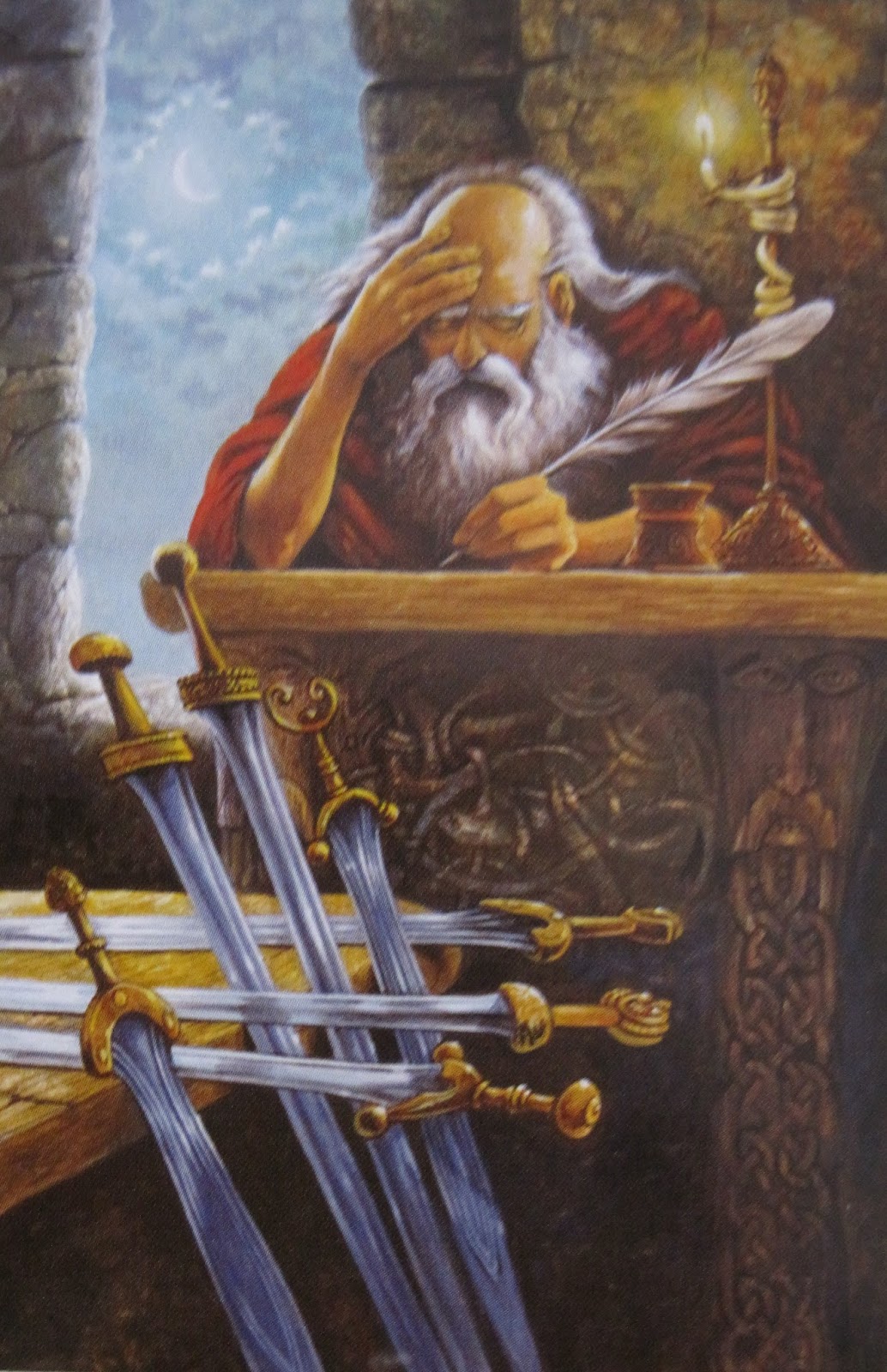
Aquarius in the DruidCraft Minor Arcana: The Seven of Swords


The Seven of Swords, in the astrological correspondence system I follow, is linked to the Moon in Aquarius - as well as to the final ten days of Aquarius (9th/10th-18th February this year).   We’re still looking at Fixed Air, but now we add some water through Cancer’s rulership of the Moon.  


So if this is the sign of the unconventional and the unorthodox, the reformer and revolutionary, how is it affected by the Moon?  Well, the Moon is about emotional needs and about the way we react to things automatically, instinctively.  So an Aquarian Moon could react unpredictably, perhaps, and with a sense of detachment.  Being free to express ideas, especially ones that don’t conform to the ‘norm’, and to be innovative might give this Moon a sense of security.


But how does this fit with the Seven of Swords? This card is often linked to being stealthy – one of my tarot friends, Alison Cross, calls it the ‘Sneaky Pete’ card.  Some say it’s about making a sly escape, but I like Juliet Sharman-Burke’s description – “tact rather than aggression”.  There’s something about thinking things through and making plans for the future (Aquarius) but taking great care with those plans. Remember the Moon is ruled by Cancer, so there’s likely to be an element of protectiveness involved – possibly to the point of being underhanded.  Aquarius brings the detachment, the clarity of vision, so that any protectiveness or nurturing quality to the action is not going be based on emotional needs.  We often warn against being too free and open about what we intend to do when we see this card – that’s the Moon’s caution acting on an Aquarian desire to spread knowledge within the community.
 
Seven of Swords (trimmed):
DruidCraft Tarot


But can we see this at work in the DruidCraft, a deck not designed with astrology in mind?  I can see the Aquarian at work here, the person working with ideas, with words, with concepts – and the man in the image looks as though he’s taking great pains with his plans.  The stealthiness is less obvious, I think, but the deck’s creators, Philip and Stephanie Carr-Gomm, write about the potential need to meet a challenge with cunning and manipulation, as well as being bold and daring – the more Aquarian approach - in the accompanying book.  The Moon representing the creation of illusion through cunning, perhaps, shining through the window?


The authors also write about another interpretation: “new ideas challenge old assumptions, insights and fresh ideas spring up, and great progress is made”.  I love the use of the word “spring” here – in the northern hemisphere, at least, the first stirrings of spring fall in Aquarius!  


DruidCraft Tarot created by Philip Carr-Gomm and Stephanie Carr-Gomm, illustrated by Will Worthington, published by Connections 2004