Showing posts with label Juliet Sharman-Burke. Show all posts

Monday, 30 September 2019

Sitting in Judgement


I’ve been challenged, recently, about my interpretation of the Judgment card.  In a reading, I’d said that Judgment wasn’t about judging and being judged – or at least, not only about that.  But others clearly don’t agree, so I thought I’d have a look and see what other views are around.

© Judgement
Universal Waite Tarot
The Little White Book (LWB) that accompanies the Universal Waite Tarot deck simple says “Change of position, renewal, outcome.”  Short and to the point. 

Rachel Pollack, in her Seeker: The Tarot Unveiled (Llewellyn, 2005), adds “rebirth, new possibilities, and wholeness” to the list.  In fact, she maintains (as do I) that Judgment is not about judging others, showing good judgement, or being judged themselves at all.  The child in the image reminds us that new opportunities and possibilities can appear when we heed the voice that tells us to let go of old, out-of-date, ways and beliefs.  The nakedness of the figures symbolizes openness as well as new beginnings – the state in which we were born into this world, but also the state in which we need to embrace this “re-birth”.  The trumpet, far from being the call to judgement, is in fact the “voice”, the push, the call – however it manifests – to step into the unknown and stop hiding.

© Judgement
Game of Thrones Tarot
Juliet Sharman-Burke, in her Beginners Guide to the Tarot (Connections, 2001), adds “resurrection and resolution” to the list.  She too sees this as an opportunity to greet the new with joy.  She calls it the card of karma, saying “it heralds the time of reaping what has been sown”.  You might see an element of judgement in that but, reading between her lines, I feel it’s more about assessment.  Yes, she does use the word “judge” – “to judge your actions and appraise what you have done” – but she goes on to say it’s more about the preparation for the next stage in life. 

Liz Dean, in the accompanying guidebook to The Game of Thrones Tarot (Home Box Office, Inc., 2017), doesn’t use the word “judgement” in her description of the card.  She writes about being on the edge of a change, and focuses on the need for second chances after a review or appraisal, and about the chance to make sense of the past.

© Judgement
Shadowscapes Tarot

In the accompanying book to the Shadowscapes (Tarot Llewellyn, 2010), Stephanie Pui-Mun Law and Barbara Moore do refer to making a judgement.  They talk about holding an accounting, and about it being “time to evaluate the phase of life just past, to recognize and to appraise with an unbiased mind and honesty to oneself”.  They too see Judgement as a card of awakening, of hearing and responding to a voice or call, and the need to respond to it.


The creators of the Wildwood Tarot (Connections, 2011), Mark Ryan and John Matthews, are very clear in their view.  In the accompany book, they write that “The major element in this process [surviving inevitable change] is judgement of yourself and others.”, yet the word “judgement” doesn’t come up in their list of keywords.  “Karma” and “cosmic law” do, as does “inescapable truth”.  They do talk about renewal and rebirth, themes that are echoed in the image that Will Worthington has created for the card.  That idea of rebirth is also seen in the DruidCraft Tarot’s image (also by Will Worthington).


© The Great Bear
Wildwood Tarot
© Rebirth
Druid Craft Tarot


So yes, my challenger was right in saying that the card is about judging the self and others, but I think perhaps it depends on how we define “judgment” – and maybe I need to be clearer about that when I read!  (To be fair, the deck I was reading with, Kim Krans’ Wild Unknown Tarot, does focus on the forgiveness aspect, as I did in the reading.)  Kim Krans’ view is that the word carries such negative connotations – fear, guilt, shame – that it’s more helpful to seek the truth and forgive, not blame.  The image, the dove rising up above all the negativity (the darkness) and spreading its wings reflects that beautifully, I think.


© Judgement
Wild Unknown Tarot
Pollack, Rachel. Seeker: The Tarot Unveiled. Llewellyn Publications, 2005.


Beginner’s Guide to the Tarot created by Juliet Sharman-Burke, illustrated by Giovanni Caselli, published by Connections
Druid Craft Tarot created by Philip Carr-Gomm and Stephanie Carr-Gomm, illustrated by Will Worthington, published by Connections
Game of Thrones Tarot, created by Liz Dean, published by Home Box Office, Inc., 2017
Shadowscapes Tarot created by Stephanie Pui-Mun Law and Barbara Moore, published by Llewellyn
Universal Waite Tarot created by Mary Hanson-Roberts & Pamela Colman-Smith, published by U.S. Games Systems, Inc.
Wild Unknown Tarot, created by Kim Krans, published by HarperCollins, 2016.
Wildwood Tarot created by Mark Ryan and John Matthews, illustrated by Will Worthington, published by Connections


Thursday, 8 February 2018

Aquarius in the Minor Arcana: The Seven of Swords

The Seven of Swords, in the astrological correspondence system I follow, is linked to the Moon in Aquarius - as well as to the final ten days of Aquarius (10th-19th February this year).   We’re still looking at Fixed Air, but now we add some water through Cancer’s rulership of the Moon.  

So if this is the sign of the unconventional and the unorthodox, the reformer and revolutionary, how is it affected by the Moon?  Well, the Moon is about emotional needs and about the way we react to things automatically, instinctively.  So an Aquarian Moon could react unpredictably, perhaps, and with a sense of detachment.  Being free to express ideas, especially ones that don’t conform to the ‘norm’, and to be innovative might give this Moon a sense of security.

Seven of Swords (trimmed):
© Sharman-Burke/Caselli Tarot
But how does this fit with the Seven of Swords? This card is often linked to being stealthy – one of my tarot friends, Alison Cross, calls it the ‘Sneaky Pete’ card.  Some say it’s about making a sly escape, but I like Juliet Sharman-Burke’s description – “tact rather than aggression”.  There’s something about thinking things through and making plans for the future (Aquarius) but taking great care with those plans. Remember the Moon is ruled by Cancer, so there’s likely to be an element of protectiveness involved – possibly to the point of being underhanded.  Aquarius brings the detachment, the clarity of vision, so that any protectiveness or nurturing quality to the action is not going be based on emotional needs.  We often warn against being too free and open about what we intend to do when we see this card – that’s the Moon’s caution acting on an Aquarian desire to spread knowledge within the community.

Seven of Swords (trimmed):
© Shadowscapes Tarot
The Shadowscapes Tarot shows us that stealthiness by a figure hiding behind a mask, having just managed to steal a sword from the swan that guards them. He thinks he hasn’t been seen but in fact the swan has one eye open and knows exactly what’s going on.  Here we can see the Moon in the idea of deception (the Moon card in the tarot is about illusion and deception, among other things).  A life lived in stealth and in deception suggests a lack of faith in the world, and that this is the only way to get what you need.  Which brings us to negative thoughts...


Seven of Swords (trimmed):
© Thoth Tarot
In the Thoth Tarot, the word that Crowley chose for the card is ‘futility’ – a daunting card to be faced with, I often feel.  As with many of the cards in this deck, I feel it’s coming from the other direction – but yet still brings us to the same point (oh, sorry – no pun intended!).  The six smaller swords each bear a glyph on their hilts, representing six of the planets.  Each of those smaller swords is meant to represent thoughts which stand in our way – negative thoughts. For instance, Mars could symbolize feeling too tired, or that there’s not enough time – while Neptune could reflect a sense of not really knowing what you want, that it’s all an illusion. Meanwhile, the Sun and Moon – the conscious and unconscious – are at opposite ends of the seventh and largest sword; the Sun glyph on its hilt, pointing towards the Moon at the top of the card. The message? Not to let a sense of it all being ‘futile’ stand in your way – by doing so, you’re actually trying to escape taking responsibility for your actions – hence the stealthy appearance of the guy in the more traditional images!


Beginner’s Guide to the Tarot created by Juliet Sharman-Burke, illustrated by Giovanni Caselli, published by Connections
Shadowscapes Tarot created by Stephanie Pui-Mun Law and Barbara Moore, published by Llewellyn
Thoth Tarot created by Aleister Crowley, illustrated by Lady Frieda Harris, published by U.S. Games Systems, Inc.


Sunday, 28 January 2018

Aquarius in the Minor Arcana: The Five of Swords

Let’s continue our exploration of Aquarius in the tarot with a dip into the Minor Arcana.  In the astrological correspondence system that I follow, Aquarius is linked to the Five, Six and Seven of Swords (for more information on this system, I recommend Elizabeth Hazel’s Tarot Decoded, published by Weiser, 2004). Today I’m going to look at the Five of Swords, which corresponds to Venus in Aquarius – as well as the first ten days of Aquarius (so from the 20th to the 29th-30th January this year).

Five of Swords (trimmed):
© Sharman-Burke/Caselli Tarot
Aquarius is the fixed Air sign, so we’re looking at maintaining lines of communications, and establishing ideas and concepts – but not just any old idea. This is the sign of the unconventional and the unorthodox, the reformer and revolutionary.  When we add Venus, the ‘principle of attraction’, to this we have a sign that expresses itself freely, perhaps flirtatiously – but very likely in an experimental way.  Aquarius can be detached and impersonal, so that flirtation might be very superficial and could impede the development of intimate relationships.  There’s a strong need for active socializing, for establishing groups based around a common cause, but this will be influenced by beliefs in individual freedom and expression, which could lead to conflict if not managed.

So how might this play out in the Five of Swords?  Let start with a relatively ‘traditional’ depiction of the Five of Swords, such as that of the Sharman-Burke/Caselli deck. Here we see a figure standing in a triumphant pose, holding three swords aloft while the other two lie at his feet.  Two figures behind him are creeping away in defeat, heading towards choppy waters and a stormy-looking sky.   Juliet Sharman-Burke, in her accompanying book to this deck, writes of needing to ‘accept the limits of both victory and defeat’.  The limits come through the fixed-ness of Aquarius, I feel – needing to recognize that there are limits to what we want to achieve, what we’re attracted to (the Venusian quality). Not that we have to give up, necessarily, but to accept a ‘temporary defeat’ or setback by objectively (Aquarius again) assessing how strong we are, be it as an individual or group, in relation to our opponent, be that another individual or community, and being able to step back from a battle that can’t be won.  A battle – not the ‘war’.  By knowing when to walk away from a situation or relationship, whatever it might be, we live to fight another day for what we believe in, what we’re pulled towards – the attraction principle, again.
Five of Swords (trimmed):
© Druid Craft Tarot

The Druid Craft’s image for this card is a relatively ‘traditional’ depiction, with a figure standing in a triumphant – or perhaps defiant - pose, holding three swords while the other two lie at his feet.  A hunched figure behind him slumps away in defeat – the risk of defeat over his belief in freedom of expression, perhaps?  The victor in this case may have acted without compassion or humility – the downside of Aquarian’s detachment, maybe.


In the Shadowscapes and Thoth decks, the emphasis is the same, although the images are different.  Things are out of balance due to the tension or conflict between ideologies, say – the harmony that we normally associate with Venus has been lost.  Aquarius looks towards the future though – it’s the forward-thinking sign.  The challenge is to stay objective, to be able to look at the situation clearly and to assess the options open to us, rather than succumbing to the loss of hope – the Venusian/Aquarian ideal.

Five of Swords (trimmed):
© Thoth Tarot
Five of Swords (trimmed):
© Shadowscapes Tarot


If you’ve enjoyed this post, you might be interested in my e-book, Astrology in Tarot, now available from Amazon.


Beginner’s Guide to the Tarot created by Juliet Sharman-Burke, illustrated by Giovanni Caselli, published by Connections
Druid Craft Tarot created by Philip Carr-Gomm and Stephanie Carr-Gomm, illustrated by Will Worthington, published by Connections
Shadowscapes Tarot created by Stephanie Pui-Mun Law and Barbara Moore, published by Llewellyn
Thoth Tarot created by Aleister Crowley, illustrated by Lady Frieda Harris, published by U.S. Games Systems, Inc.


Thursday, 18 January 2018

Capricorn in the court cards

Now let’s look at Capricorn in the court cards. But which one – or ones?  For instance, the Hermetic Order of the Golden Dawn chose to assign cardinal attributes (initiating things) to the Queens, fixed (maintaining order) to the Kings, and mutable (being able to adapt and transform) to the Knights.  Each court card is also linked to the elements, with Pages with Earth, Knights being associated with Fire, Queens with Water, and Kings with Air. 

Queen of Pentacles (trimmed):
© Universal Waite Tarot
Following this system, we end up with Cardinal Earth sign Capricorn being associated with the Queen of Pentacles (Water of Earth). What qualities do we associate with this Queen? Pragmatic, well-organized, good with finances, a loyal friend who’s always ready to listen and dispense practical advice.  As well as finances and possessions, she also represents taking care of – and taking pleasure in – the body.  We also associate her with caring for the earth – and enjoying its wealth.

Plenty of goat imagery in the Universal Waite's Queen of Pentacles! We also see plenty of symbolism around nature, a connection to the land, and the enjoyment of its riches.

Queen of Disks (trimmed):
© Thoth Tarot
The Crowley Thoth’s Queen of Disks is one of my favourite representations of this card. We see her resting in a green and fertile oasis, looking back over the barren, difficult landscape that she’s had to travel through to reach this point. The goat looks at us, rather cheekily, I always think – as if to say “see? We made it!” – reminding us of the tenaciousness and independence of the mountain goat as he surmounts obstacles in his way. We see this too in the curved horns on the Queen’s headdress.  Remember too, what we said about the goat when we looked at the Devil – that it also represents procreation and new life.  This Queen knows what she needs in order to nourish herself – and others – and has worked hard to achieve it. Now she can rest and enjoy the fruits of her labours.


King of Pentacles (trimmed):
© Sharman-Burke/Caselli Tarot
If you work with a system that assigns cardinality to the Kings, you’re looking at the King of Swords.  In the image from Juliet Sharman-Burke’s Beginners’ Guide to the Tarot, we see the King on his throne, adorned with carvings of goats’ heads, symbolizing Capricorn and the steady, determined hard work that’s helped him to realize his ambition. Behind him we see his castle and grounds – symbols of his achievement, both in terms of material success but also of his status in society. They also appear to be on top of a mountain, reminding me of the sure-footed-ness of the mountain goat as he picks his way around obstacles in his way to the top. Security and stability have been gained through effort and sheer determination, and the King is now in a position to share this wisely and generously.


If you’ve enjoyed this post, you might be interested in my e-book, Astrology in Tarot, now available from Amazon.


Beginner’s Guide to the Tarot created by Juliet Sharman-Burke, illustrated by Giovanni Caselli, published by Connections
Thoth Tarot created by Aleister Crowley, illustrated by Lady Frieda Harris, published by U.S. Games Systems, Inc.
Universal Waite Tarot created by Mary Hanson-Roberts & Pamela Colman-Smith, published by U.S. Games Systems, Inc.


Monday, 1 January 2018

Capricorn in the Major Arcana – The Devil!

Happy New Year!

Carrying on with our exploration of Capricorn, we come now to The Devil – but why? What’s the link between the two?

XV Cernunnos (trimmed):
© Druid Craft Tarot
Well, goats have come to symbolize sexuality in many mythologies – for instance, Pan, the Greek goat-god, who was linked to the idea of ‘wild desire’.  In northern European traditions, we have the Horned God, or the Celtic Cernunnos, representing nature and sensuality. Throughout the ages, though, the goat has also become almost synonymous with the Devil, supposedly representing temptation and giving in to our desires.   With Capricorn being an Earth sign, the references to sensuality and physical desire can be extended to material desires. So when we come across the Devil in the tarot, we’re reminded about what’s overpowering or obsessive, the things we try to suppress or deny. It can represent not only temptation, but also surrender – and reminds us that we have the power within us to keep our feet on the ground! 

XV The Devil (trimmed):
© Haindl Tarot
Hermann Haindl’s depiction of the Devil shows both a goat, the traditional Capricorn image, and a serpent. Rachel Pollack, in her Haindl Tarot: A Reader’s Handbook (published by Llewellyn, 2005), talks about kundalini energy being raised by both creatures, through the spirals of the goat’s horns and the coils of the serpent. 

XV The Devil (trimmed):
© Thoth Tarot
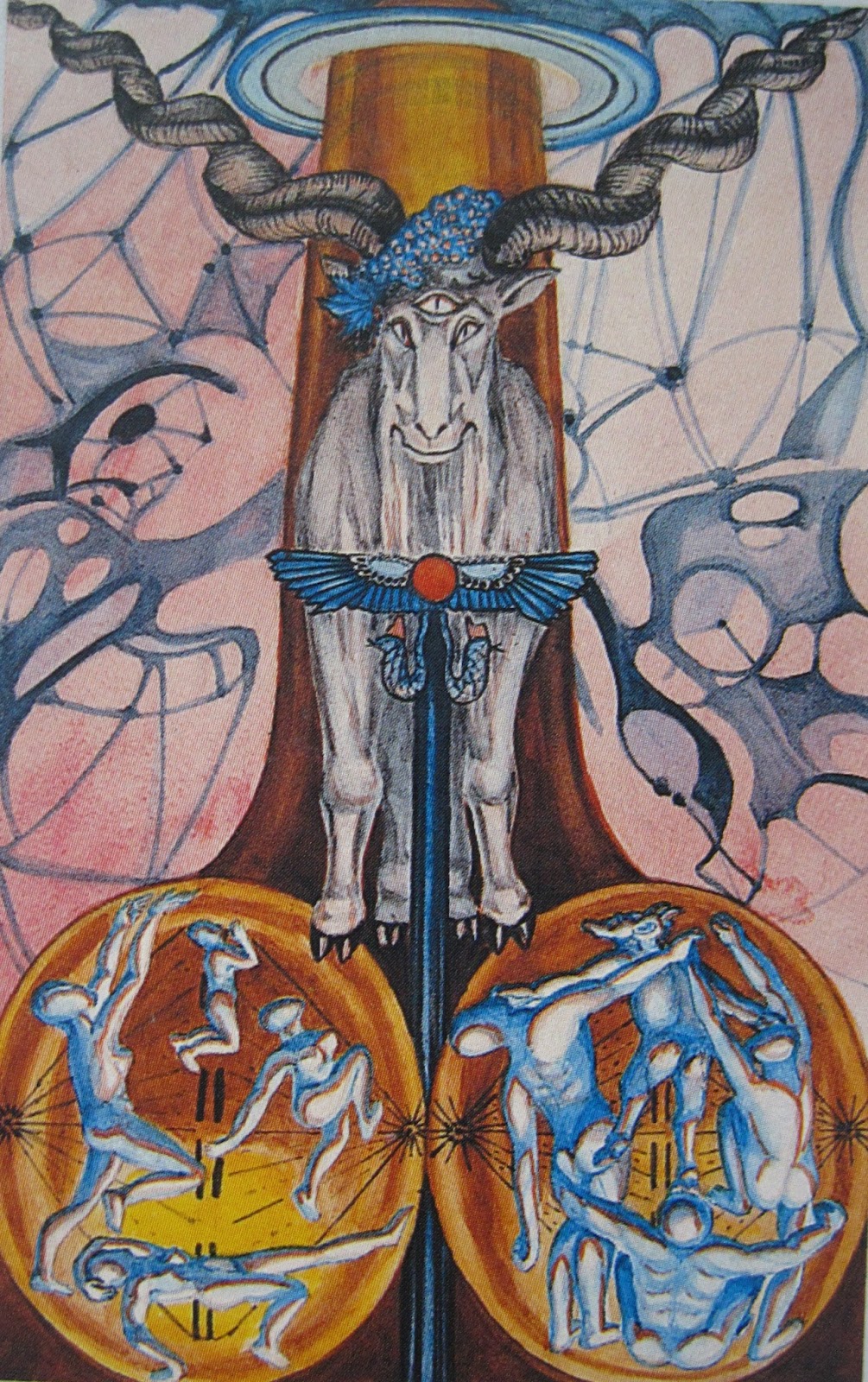
The Devil in Crowley’s Thoth deck always makes me laugh – who can resist that wicked grin of that goat?!  Laughing at how we become imprisoned by our desires and obsessions...and those twisted horns remind me of the twisted sense of humour... There’s an emphasis here on the procreative energy, too, with a very obvious phallic symbol taking centre-stage.


The Devil (trimmed):
© Sharman-Burke/Caselli Tarot
These images are quite different from the more traditional depictions of The Devil, yet the messages are similar. Juliet Sharman-Burke talks about “power and energy imprisoned”, the Devil-goat in the image symbolizing the material world, to which the figures have voluntarily chained themselves – there are chains around their necks but those chains aren’t right, and the figures’ hands are not restricted at all.  I see Saturn, the ruler of Capricorn, coming into play here – those figures show no indication of wanting to make any change, to escape the restrictions they’ve placed on themselves.  Sharman-Burke goes on to say “The Devil refers to all that is dark within your own psyche. That is why we like to think of The Devil’s abode as deep within the bowels of the earth in a place so safely removed from us that we do not have to deal with him. However, such an attitude also means that we live in fear of The Devil, and remain chained to his block of inhibition, restricted because we cannot face the truth about ourselves.”  (The Beginner’s Guide to the Tarot, Juliet Sharman-Burke, Connections 2001)

XV The Devil (trimmed):
© Shadowscapes Tarot
In the Shadowscapes deck, Stephanie Pui-Mun Law gives us a much more ethereal view of The Devil, but we still see that figure seemingly imprisoned – yet not allowing herself to see that there’s an obvious way out. Rather than choose to see the beauty around her, she hides her eyes – what is it she’s so afraid of? The Devil dances above her, laughing at how easy it is to keep what should be a vibrant creature a prisoner – a prisoner of her own fears.


So The Devil acts as a reminder to free ourselves of those restrictions we placed on ourselves and surrender to earthy sensuality (which, as a double Taurus, I shouldn’t have any problems with!) and to meet those who would ‘demonize’ us and what we believe in with humour!


If you’ve enjoyed this post, you might be interested in my e-book, Astrology in Tarot, now available from Amazon.


Beginner’s Guide to the Tarot created by Juliet Sharman-Burke, illustrated by Giovanni Caselli, published by Connections
Druid Craft Tarot created by Philip Carr-Gomm and Stephanie Carr-Gomm, illustrated by Will Worthington, published by Connections
Haindl Tarot, created by Hermann Haindl, published by U.S. Games Systems, Inc.
Shadowscapes Tarot created by Stephanie Pui-Mun Law and Barbara Moore, published by Llewellyn
Thoth Tarot created by Aleister Crowley, illustrated by Lady Frieda Harris, published by U.S. Games Systems, Inc.


Friday, 1 December 2017

Sagittarius in the Minor Arcana: The Eight of Wands

Moving on now to the Minor Arcana, in the astrological correspondence system that I follow, Sagittarius is linked to the Eight, Nine and Ten of Wands. Today I’m going to look at the Eight of Wands, which is linked to Mercury in Sagittarius, and corresponds to the first ten days of Sagittarius (this year, 22nd November to 1st December).

Sagittarius is the mutable Fire sign, so we’re looking at transforming what’s been established into something else.  It combines a fiery passion and creativity with the expansiveness and benevolence of Jupiter, the ruler of Sagittarius, to give us the visionary, the explorer, the philosopher.   

Eight of Wands (trimmed):
© Druid Craft Tarot
Mercury is associated with communication, so when linked with Sagittarius could indicate fast thinking, perhaps, or open and optimistic communication.  Ideas are probably more to do with long-term goals or aspirations towards an ideal. Getting bogged down by details seems unlikely, and there could be a sense of restlessness involved.  There might also be an interest in teaching others about what we’ve learned in our own journey. Tolerance and broad-mindedness are also qualities of this combination of planet and sign.

Mercury rules Gemini, the sign that sits opposite Sagittarius in the zodiac.  Opposing forces at work here, you might think.  Rather than buzz about pollinating local networks, Mercury is being challenged here to work on a much larger scale. Global rather than local. 

Eight of Wands (trimmed):
© Sharman-Burke/Caselli Tarot
So how might this play out in the Eight of Wands?  Let start with a relatively ‘traditional’ depiction of the Eight of Wands – as illustrated by the Sharman-Burke/Caselli (Beginners Guide to the Tarot) and Druid Craft decks. Here we see wands flying through the air, representing new directions and many opportunities or possibilities.  There’s plenty of space for ideas – represented by flames on the wands - to expand and grow.  The wands are in their element, literally, in Sagittarius.  Juliet Sharman-Burke uses the phrase ‘full steam ahead’ to describe this card; steam is a product of fire and water, taking me back to the idea of Temperance and alchemy! There’s a goal – maybe more than one – to aim for (the castle in the background representing hopes and wishes). The thing to be wary of here is that if the activity is so widespread, it’s possible that nothing will ever be completed! Focus that creative fire into fewer things.

Eight of Wands (trimmed):
© Shadowscapes Tarot
The Shadowscapes version of this card shows the seeds of ideas being carried away on the wind – being communicated and transported in a Mercurial fashion. In the accompanying book, the deck’s creators write “the seeds spin away on the wild winds – at the mercy of entropy but sailing with the purpose nature bestowed on them... and then set down to ...become a mighty tree”.   For me, that sense of being taken wherever nature carries them reflects the Sagittarian expansion by Mercurial means!

Eight of Bows (trimmed):
© Wildwood Tarot
In the Wildwood we have the Eight of Bows.  We see people gathered around a fire, celebrating, perhaps.  Here’s Mercury – gathering, communicating, and sharing with friends and neighbours.  This, to me, seems more about the aftermath of going out and achieving the Sagittarian quest, whatever it might be, rather than the wands being sent out through the air - although you could argue that there's plenty of "spreading the word" going on around the fire!

Eight of  Flames (trimmed):
© Margarete Petersen Tarot

Margarete Petersen’s Eight of Flames gives us a big cat – a cheetah perhaps, as it’s the fastest of all the felines – above and to the left of a figure with a bow and arrow. The bow reminds me of the Wildwood’s use of Bows in place of Wands…  The arrow hasn’t been released yet, so this might not be so much the end of the action, as in Waite-Smith-based images.  It could signify the sending of news, or maybe even reflecting on what releasing the arrow might manifest.

Eight of Wands (trimmed):
© Thoth Tarot

In the Thoth deck, the image is very different – yet the meaning is similar. The card carries the word ‘swiftness’, which we see in the images on the other cards; there’s a sense of those arrows flying at speed through the air.  Here the arrows are red (fire), shooting off in all directions. Communication is clear (the crystal), direct and honest, so that misunderstandings can be avoided or overcome.   Make sure you know where you stand, and that it’s clear to the world!


If you’ve enjoyed this post, you might be interested in my e-book, Astrology in Tarot, now available from Amazon.


Beginner’s Guide to the Tarot created by Juliet Sharman-Burke, illustrated by Giovanni Caselli, published by Connections
DruidCraft Tarot created by Philip Carr-Gomm and Stephanie Carr-Gomm, illustrated by Will Worthington, published by Connections
Margarete Petersen Tarot, AGM-URANIA/Deep Books, 2004.
Shadowscapes Tarot created by Stephanie Pui-Mun Law and Barbara Moore, published by Llewellyn
Thoth Tarot created by Aleister Crowley, illustrated by Lady Frieda Harris, published by U.S. Games Systems, Inc.
Wildwood Tarot created by Mark Ryan and John Matthews, illustrated by Will Worthington, published by Connections


Thursday, 9 November 2017

Scorpio in the Minor Arcana: The Six of Cups

Back to the Minor Arcana! Today we move on to the Six of Cups, which - in the system I use - is linked to the second decan (2nd- 11th November) as well as the Sun in Scorpio.

Just to recap: Scorpio is the fixed Water sign, so Scorpio will want to know what’s going on at a deeper level, not at the bubbly surface – “still waters run deep” is a good description of Scorpio’s focus.  Scorpio has to dive into the depths in order to unearth the root of a problem and will then try to transform it – but it may take a crisis or something similar before Scorpio will take that plunge. 

Six of Cups (trimmed):
© Sharman-Burke/Caselli Tarot
But here we have Sun in Scorpio – the addition of warmth and light!  Sounds like the complete opposite of dark and intense Scorpio, you might think?  If we think in terms of the Sun representing our creative energy, then in Scorpio that creativity is going draw on our emotions and intuition at a very deep level.  This could be seen as the need to express our creativity by changing or transforming something.  The Sun also represents our core being, our vitality – and in Scorpio this could connect us to our inner desires, perhaps even compulsions or obsessions.  The ‘shadow’ side of this – the reversal, if you like – could be seen as emotional obsessions or fixations getting in the way of the expression of creative energy, or perhaps the fear of losing control.

How is the Sun in Scorpio reflected in the Six of Cups?  If we think of themes of ‘past memories and future dreams’ (Juliet Sharman Burke’s keywords), we can see how nostalgia becomes a place of refuge when what’s going on in the present is too difficult to face.  The harmony (Six) and the gentleness (Cups) feel warm – like the Sun’s energy, allowing us to penetrate what’s going on at the surface and to go deeper into the root of the issue.  Juliet Sharman-Burke also talks about the idea of old love reappearing or being rekindled – again, the idea of cycles, of relationships that have died coming back to life.

Six of Cups (trimmed):
© Shadowscapes Tarot
The Shadowscapes Tarot's Six of Cups conjures up lots of childhood memories for me - tea parties with teddy bears and other stuffed animals!  It reminds me that I need to be more open-minded, to look at things from a more child-like perspective - with innocence and wonder - rather than always from the jaded grown-up viewpoint.  I'm also reminded of the idea of the puer aeternus (‘eternal boy’) and its shadow, the senex (‘old man’), and the need to recognize both aspects in ourselves, rather than let one overshadow the other.

Six of Cups (trimmed):
© Thoth Tarot
The downside, or ‘shadow’, of the Sun in Scorpio/Six of Cups is the potential trap of living in the past. That takes us back to the images of the Five of Cups – focusing on what’s past and ignoring what we still have.  Following that theme, remember the lotus roots in the Thoth Tarot’s Five of Cups, and how they formed a butterfly-shape? Well, in the Thoth’s Six of Cups, we see that lotus in its opened, receptive form – it’s been transformed; the fear of disappointment has been overcome so that more pleasant things can be enjoyed.  Enjoy what we have now, and let go of what’s past – that, to me, is the essence of the Sun in Scorpio!


If you’ve enjoyed this post, you might be interested in my e-book, Astrology in Tarot, now available from Amazon.

Beginner’s Guide to the Tarot created by Juliet Sharman-Burke, illustrated by Giovanni Caselli, published by Connections
Shadowscapes Tarot created by Stephanie Pui-Mun Law and Barbara Moore, published by Llewellyn
Thoth Tarot created by Aleister Crowley, illustrated by Lady Frieda Harris, published by U.S. Games Systems, Inc.


Friday, 27 October 2017

Scorpio in the Minor Arcana: The Five of Cups

Let’s start our exploration of Scorpio in the tarot in the Minor Arcana.  In the astrological correspondence system that I follow, Scorpio is linked to the Five, Six and Seven of Cups. Today I’m going to look at the Five of Cups, which corresponds to the first ten days of Scorpio (this year, the 23rd October to around the 1st November) – and to Mars in Scorpio.

Scorpio is the fixed Water sign, so we’re looking at maintaining our emotional resources, delving into the depths to get at the heart or root of what’s going on.

Mars, the traditional ruler of Scorpio, is associated with the element of Fire.  Mars is the warrior, the Roman god of war – powerful, passionate, driven by strong desires, and very likely to take the initiative.  Mars is decisive, and needs to express himself freely – which could come into conflict with the Scorpio preference for keeping things hidden, buried away in the depths.  Mars likes to be in control but when combined with Scorpio’s energy, this is likely to manifest through an intense transformation of emotional power at a very deep level.

Five of Cups (trimmed):
© Sharman-Burke/Caselli Tarot
So how might this play out in the Five of Cups?  Let‘s start by looking at a relatively ‘traditional’ depiction of the Five of Cups, from the Sharman-Burke/Caselli deck (Beginners Guide to Tarot). Here we see a figure facing away from us, looking down at the three overturned cups in front of him. He’s so intent on these and what’s spilling out of them, that he doesn’t see the two that still stand, intact.  Juliet Sharman-Burke uses the words ‘regret’ and ‘sorrow’ for this card. So we have someone who feels deep sorrow at what’s happened (the three cups emptying), but who’s ignoring or overlooking at what still exists (the two full cups).  The decisiveness and freedom of expression that Mars would usually exert is being held back by the compulsion to look only at the loss and the emotions that accompany it – to become lost in the emotion itself perhaps?
Five of Cups (trimmed):
© Shadowscapes Tarot

In the Shadowscapes Tarot, we have a slightly different interpretation. The figure is ignoring the three overturned cups at her feed, focusing on the one in her hands. The fifth cup bobs on the waves in front of her – does she see it? Which one holds her hopes – the one she’s gazing into with Martian determination, or the one that’s trying to head out to sea with Martian determination of its own?  Perhaps the cup she holds represents what’s happened, and her feelings of sorrow or disappointment, while the cup on the waves is pushed and pulled by the tide, unable to move forward. Again, the decisiveness and freedom of expression associated with Mars being held back by being lost in the emotion of loss.

Five of Cups (trimmed):
© Thoth Tarot
In the Thoth deck, the emphasis is the same – regret, sorrow, and the disappointment of unfulfilled expectations.  The cups are empty and look as though they could easily break. The lotus has been uprooted, and its blossoms have died. Even the water looks dead.  But the roots of the lotus form a butterfly shape, representing the idea of transformation – the theme of Scorpio.  The card warns against allowing the potentially aggressive, potentially destructive Martian energy to spill over.  That energy can be used usefully though, by transforming it – by shifting the emphasis from what’s lost to what’s still available to us. We can learn from disappointment – nothing is ever wasted. Remember that Scorpio represents cycles, endings and beginnings – and is the ultimate recycler!


Five of Vessels (trimmed):
© Wildwood Tarot
The Wildwood, on the other hand, shows us a rather different view!  Although Mark Ryan and John Matthews, the deck’s creators, haven’t use astrological correspondences I see Will Worthington's figure symbolising the passion of Mars, using that energy to travel to deep levels through dance.  I think here of shamanic work – dancing in trance – and the revelations and transformations that can come through this. Powerful stuff!

Beginner’s Guide to the Tarot created by Juliet Sharman-Burke, illustrated by Giovanni Caselli, published by Connections
Shadowscapes Tarot created by Stephanie Pui-Mun Law and Barbara Moore, published by Llewellyn
Thoth Tarot created by Aleister Crowley, illustrated by Lady Frieda Harris, published by U.S. Games Systems, Inc.
Wildwood Tarot created by Mark Ryan and John Matthews, illustrated by Will Worthington, published by Connections