Showing posts with label Shadowscapes Tarot. Show all posts

Monday, 23 September 2019

Tarot Blog Hop Mabon 2019: What is my harvest, and how do I find it?


Welcome to Alison’s Alembic! You may have arrived here as a stop on the Tarot Blog Hop from either Tarot and Stars' or Tarot of Change's blog. Or you may have found this through TABI’s Facebook page, or though one of the many wonderful tarot bloggers in the ether... It doesn’t matter – what does matter is that you’re here!

In the northern hemisphere, we're approaching the Autumn Equinox, also known as Alban Elfed, as well as the time for paying tribute to Mabon. It's the time of year when we’re poised between light and dark, with the hours of daylight and darkness being equal in length. It’s also the culmination of the harvest that was begun at Lughnasadh. At this time we celebrate the beginning of harvesting grapes, making wine, bringing in the sheaves for the canning, preserving, and other ways of gathering the fruits of months, sometimes years, of effort and care.

With all this in mind, our wrangler for this particular Blog Hop, Aisling, has given us the title

What Is My Harvest, and How Do I Find It?

She’s asked us to focus on the collecting of our personal harvest – what we’ve learned, what we’ve decided is important, what we’ve have decided to get rid of. How are we planning to make productive use of the autumn and winter months? How have we changed, what are we beginning, and what have we completed, and – most importantly, how have we begun to further and more deeply understand our ‘self’?

Aisling’s suggested using the concept of the Three Realms – Land, Sea, and Sky – to represent Body, Mind, and Spirit, and to draw three cards for each of the Realms, nine cards altogether. In each case, the cards will answer three questions, one set for Body, one for Mind, and one for Spirit.

These are the questions:

1. What do I need to know about the current condition of my body/mind/spirit right now?

2. What is the most important thing on which I need to focus in the realm of my body/mind/spirit as I move into the winter months?

3. What is the main content and context of this harvest of better health/new ideas/deeper spiritual resonance that I am going to receive if I focus on these things?


So, here goes! I’m using Stephanie Pui-Mun Law’s lovely Shadowscapes deck.  
This is what it looks like, overall – bottom row: Land, middle row: Sea, top row: Sky...


All cards © Stephanie Pui-Mun Law

Starting with the first column (left-hand-side), Body –


Card 1, at the bottom (Land), represents what I need to know about the current condition of my body, my health, right now. The Page of Wands tells me that I’m in the early stages of a new phase, and that it’s good news. That’s encouraging! With this being Wands and the suit of action and adventure, I see this as a pointer to do as much travelling and exploring as I can while I still have good health and the ability to do so.

Card 2, in the middle (Sea), represents the thing that’s most important for me to focus on as we move towards winter in terms of my health, or body. The Ace of Cups suggests more beginnings, but on an emotional front. That’s good too – emotional happiness has an effort on the body, and vice versa.

Card 3, at the top (Sky), represents what it is I will harvest in terms of improved health. The Ten of Pentacles indicates continued good health – not just in the body but in all material areas.


Moving over to the middle column, Mind –

Card 4, at the bottom (Land), represents what I need to know about the current condition of my mind right now. The World reminds me that I’ve achieved a lot this year, even if I haven’t always been aware of it. Despite difficulties there’s also been joy. New ideas for the coming months are about to seed themselves…

Card 5, in the middle (Sea), represents the thing that’s most important for me to focus on as we move towards winter in terms of my mind, my thoughts and beliefs. The Two of Swords indicates the need to stop procrastinating, something I’ve been doing a lot of recently. Find workable solutions – not necessarily perfect ones!

Card 6, at the top (Sky), represents what it is I will harvest in terms of new ideas. Another Two, the Two of Cups suggests a coming together of ideas. Moving from the edginess of the Swords to the softer Cups, from procrastination to creativity – bring it on!

And finally, the third (right-hand-side) column, Spirit –


Card 7, at the bottom (Land), represents what I need to know about the current condition of my spirit right now. The Ace of Wands tells me that a new spark is ready to be ignited, that within me there’s a way forward just raring to go! My spirit is lifted by the thought of travel and adventure of all kinds, and by the creativity that is born through such wanderings.

Card 8, in the middle (Sea), represents the thing that’s most important for me to focus on as we move towards winter in terms of my spiritual growth. The Fool tells me to take a leap of faith. Instead of wondering if I’m following the ‘right’ path, just pick one (shades of the Two of Swords sitting to the left) and see where it takes me.


Card 9, at the top (Sky), represents what it is I will harvest in terms of deeper spiritual resonance. The King of Pentacles is the court card that’s associated with the decan in which I was born, so this has particular resonance for me – I feel a sense of ‘coming home’ with its appearance here. A greater wealth in terms of spirit, some of which may come from voluntary work that I’m involved in, as well as my personal spiritual work.

Even though they cross realms, I’m really struck by the appearance of the first and final Majors in the spread. Those, and the two Aces and two Twos, really give me the sense of new beginnings, which will be very welcome. I’m also drawn to the richness of the greens and golds in the ‘Land’ row; it gives me a sense of being very grounded and supported (which I am). The blue-mauves of the ‘Sea’ row suggest flow, movement (Water and Air) – a good thing on which to focus. And the blue-green of the top row (Sky) suggests emotional, creative and intellectual fulfilment to come…

Thanks so much, Aisling, for this inspiring idea!


And thank you, readers, for stopping off here on your journey through this Mabon Tarot Blog Hop!  Please do come back and read some of my other posts – and if you’re a Facebook user, you can find me at Alison’s Alembic.  

The next stops on the Tarot Blog Hop are - depending on whether you’re moving backwards or forwards through the list – Tarot and Stars or Tarot of Change. The Master List can be found here.


Shadowscapes Tarot created by Stephanie Pui-Mun Law and Barbara Moore, published by Llewellyn


Thursday, 8 November 2018

Scorpio in the Major Arcana: Death (part 2)

In Part 1 of our look at the Death card, we saw the phoenix rising from the ashes of the fire that consumed what was no longer needed – not unlike the bonfires consuming fallen leaves, or the fires in the fields, burning away the debris after the harvest – in order to prepare the ground for the new. 

Death (trimmed):
© Shadowscapes Tarot
The Shadowscapes Tarot also draws on the promise of renewal with its phoenix rising from the ashes of the devastation, the tearing down of what has been, now ready for what’s to come. It's one of the more 'optimistic' versions of the Death card, I think - the fiery-red phoenix looks upwards and outwards towards what appears to be a sunny future... What do you think?

Death (trimmed):
© Zillich Tarot
Christine Zillich’s and Margarete Petersen’s Death cards both invoke the Crone in their depictions of Death. There’s an element of looking backwards and forwards with the Crone-Hermit, and that ‘crone knowledge’ or wisdom associated with the Hermit is necessary in order to make the changes that Death demands. 

The Zillich Tarot’s Death shows a crone-like figure in black, butterflies – a symbol of transformation – around her. 
Death (trimmed):
© Margarete Petersen Tarot

In Margarete Petersen’s version, we see two serpents – another symbol of transformation: one white, one black. There are links back to her High Priestess, Chariot, and even the Lovers in the way she’s used duality and opposites in her work. Her Death image is almost a mirror image: white serpent meets black serpent; Death, in the form of a cloaked skeleton, stands behind the white, earth-bound figure. Out of the dark comes light. A bit like the phoenix, then?


Margarete Petersen Tarot, AGM-URANIA/Deep Books, 2004.
Shadowscapes Tarot created by Stephanie Pui-Mun Law and Barbara Moore, published by Llewellyn
Zillich Tarot, created by Christine Zillich, published by U.S. Games Systems, Inc.


Thursday, 8 February 2018

Aquarius in the Minor Arcana: The Seven of Swords

The Seven of Swords, in the astrological correspondence system I follow, is linked to the Moon in Aquarius - as well as to the final ten days of Aquarius (10th-19th February this year).   We’re still looking at Fixed Air, but now we add some water through Cancer’s rulership of the Moon.  

So if this is the sign of the unconventional and the unorthodox, the reformer and revolutionary, how is it affected by the Moon?  Well, the Moon is about emotional needs and about the way we react to things automatically, instinctively.  So an Aquarian Moon could react unpredictably, perhaps, and with a sense of detachment.  Being free to express ideas, especially ones that don’t conform to the ‘norm’, and to be innovative might give this Moon a sense of security.

Seven of Swords (trimmed):
© Sharman-Burke/Caselli Tarot
But how does this fit with the Seven of Swords? This card is often linked to being stealthy – one of my tarot friends, Alison Cross, calls it the ‘Sneaky Pete’ card.  Some say it’s about making a sly escape, but I like Juliet Sharman-Burke’s description – “tact rather than aggression”.  There’s something about thinking things through and making plans for the future (Aquarius) but taking great care with those plans. Remember the Moon is ruled by Cancer, so there’s likely to be an element of protectiveness involved – possibly to the point of being underhanded.  Aquarius brings the detachment, the clarity of vision, so that any protectiveness or nurturing quality to the action is not going be based on emotional needs.  We often warn against being too free and open about what we intend to do when we see this card – that’s the Moon’s caution acting on an Aquarian desire to spread knowledge within the community.

Seven of Swords (trimmed):
© Shadowscapes Tarot
The Shadowscapes Tarot shows us that stealthiness by a figure hiding behind a mask, having just managed to steal a sword from the swan that guards them. He thinks he hasn’t been seen but in fact the swan has one eye open and knows exactly what’s going on.  Here we can see the Moon in the idea of deception (the Moon card in the tarot is about illusion and deception, among other things).  A life lived in stealth and in deception suggests a lack of faith in the world, and that this is the only way to get what you need.  Which brings us to negative thoughts...


Seven of Swords (trimmed):
© Thoth Tarot
In the Thoth Tarot, the word that Crowley chose for the card is ‘futility’ – a daunting card to be faced with, I often feel.  As with many of the cards in this deck, I feel it’s coming from the other direction – but yet still brings us to the same point (oh, sorry – no pun intended!).  The six smaller swords each bear a glyph on their hilts, representing six of the planets.  Each of those smaller swords is meant to represent thoughts which stand in our way – negative thoughts. For instance, Mars could symbolize feeling too tired, or that there’s not enough time – while Neptune could reflect a sense of not really knowing what you want, that it’s all an illusion. Meanwhile, the Sun and Moon – the conscious and unconscious – are at opposite ends of the seventh and largest sword; the Sun glyph on its hilt, pointing towards the Moon at the top of the card. The message? Not to let a sense of it all being ‘futile’ stand in your way – by doing so, you’re actually trying to escape taking responsibility for your actions – hence the stealthy appearance of the guy in the more traditional images!


Beginner’s Guide to the Tarot created by Juliet Sharman-Burke, illustrated by Giovanni Caselli, published by Connections
Shadowscapes Tarot created by Stephanie Pui-Mun Law and Barbara Moore, published by Llewellyn
Thoth Tarot created by Aleister Crowley, illustrated by Lady Frieda Harris, published by U.S. Games Systems, Inc.


Sunday, 4 February 2018

Aquarius in the Minor Arcana: The Six of Swords

Today we move on to the Six of Swords, which - in the system I use - is linked to Mercury in Aquarius, as well as to the middle ten days of Aquarius (30th/31st January to 9th February this year).

Just to recap: Aquarius is the fixed Air sign, so we’re looking at maintaining lines of communications, and establishing ideas and concepts – but not just any old idea. This is the sign of the unconventional and the unorthodox, the reformer and revolutionary.  When we add Mercury, the communicator, the trader, to this sign we have an energy that wants to express and share its ideas, its ideology, its humanitarian aims, perhaps. Aquarius can be detached and impersonal, so the method of communicating or sharing is likely to reflect that – this won’t be about the emotions!  There could be lots of discussion, and perhaps even the establishing of groups based around a common cause that will involve the need to make changes. Innovative or experimental thinking – leading to the ‘science’ keyword used by Crowley in his Thoth deck – is also an aspect of Mercury in Aquarius.

Six of Arrows (trimmed):
© Wildwood Tarot
But how is Mercury in Aquarius reflected in the Six of Swords?  Traditionally, we tend to see the Six of Swords as being about transition – leaving behind difficult situations and moving towards a calmer place.  Often the image is one of people being carried by boat out of a stormy atmosphere into one that looks more peaceful.  The key, I think, is that we find a way out of our difficulties by coming up with new ways of thinking – that the solution comes through a different idea, perhaps even a revolutionary or unorthodox one, or one that requires some experimenting.
Six of Swords (trimmed):
© Shadowscapes Tarot


In the Shadowscapes deck, we have quite a different image but it still conveys the idea of a “passage from difficulty”, to quote the accompanying book (details below). Although the creator of the deck doesn’t draw on astrological associations, I can see Mercury’s ability to analyze and see clearly helping to bring perspective to what lies ahead (Aquarius), easing the transition.


Six of Swords (trimmed):
© Thoth Tarot
In the Thoth, the swords meeting at a central point symbolizes the meeting of a variety of ideas that results in a new vision, while the rose at the centre represents the blossoming of a new reality – the transition to a new perspective, a calmer place.  ‘Science’ here refers to the way in which new knowledge helps us to move away from outdated ways of thinking – and the need to communicate and share such knowledge so that others can adapt as well.


If you’ve enjoyed this post, you might be interested in my e-book, Astrology in Tarot, now available from Amazon.


Shadowscapes Tarot created by Stephanie Pui-Mun Law and Barbara Moore, published by Llewellyn
Thoth Tarot created by Aleister Crowley, illustrated by Lady Frieda Harris, published by U.S. Games Systems, Inc.
Wildwood Tarot created by Mark Ryan and John Matthews, illustrated by Will Worthington, published by Connections


Sunday, 28 January 2018

Aquarius in the Minor Arcana: The Five of Swords

Let’s continue our exploration of Aquarius in the tarot with a dip into the Minor Arcana.  In the astrological correspondence system that I follow, Aquarius is linked to the Five, Six and Seven of Swords (for more information on this system, I recommend Elizabeth Hazel’s Tarot Decoded, published by Weiser, 2004). Today I’m going to look at the Five of Swords, which corresponds to Venus in Aquarius – as well as the first ten days of Aquarius (so from the 20th to the 29th-30th January this year).

Five of Swords (trimmed):
© Sharman-Burke/Caselli Tarot
Aquarius is the fixed Air sign, so we’re looking at maintaining lines of communications, and establishing ideas and concepts – but not just any old idea. This is the sign of the unconventional and the unorthodox, the reformer and revolutionary.  When we add Venus, the ‘principle of attraction’, to this we have a sign that expresses itself freely, perhaps flirtatiously – but very likely in an experimental way.  Aquarius can be detached and impersonal, so that flirtation might be very superficial and could impede the development of intimate relationships.  There’s a strong need for active socializing, for establishing groups based around a common cause, but this will be influenced by beliefs in individual freedom and expression, which could lead to conflict if not managed.

So how might this play out in the Five of Swords?  Let start with a relatively ‘traditional’ depiction of the Five of Swords, such as that of the Sharman-Burke/Caselli deck. Here we see a figure standing in a triumphant pose, holding three swords aloft while the other two lie at his feet.  Two figures behind him are creeping away in defeat, heading towards choppy waters and a stormy-looking sky.   Juliet Sharman-Burke, in her accompanying book to this deck, writes of needing to ‘accept the limits of both victory and defeat’.  The limits come through the fixed-ness of Aquarius, I feel – needing to recognize that there are limits to what we want to achieve, what we’re attracted to (the Venusian quality). Not that we have to give up, necessarily, but to accept a ‘temporary defeat’ or setback by objectively (Aquarius again) assessing how strong we are, be it as an individual or group, in relation to our opponent, be that another individual or community, and being able to step back from a battle that can’t be won.  A battle – not the ‘war’.  By knowing when to walk away from a situation or relationship, whatever it might be, we live to fight another day for what we believe in, what we’re pulled towards – the attraction principle, again.
Five of Swords (trimmed):
© Druid Craft Tarot

The Druid Craft’s image for this card is a relatively ‘traditional’ depiction, with a figure standing in a triumphant – or perhaps defiant - pose, holding three swords while the other two lie at his feet.  A hunched figure behind him slumps away in defeat – the risk of defeat over his belief in freedom of expression, perhaps?  The victor in this case may have acted without compassion or humility – the downside of Aquarian’s detachment, maybe.


In the Shadowscapes and Thoth decks, the emphasis is the same, although the images are different.  Things are out of balance due to the tension or conflict between ideologies, say – the harmony that we normally associate with Venus has been lost.  Aquarius looks towards the future though – it’s the forward-thinking sign.  The challenge is to stay objective, to be able to look at the situation clearly and to assess the options open to us, rather than succumbing to the loss of hope – the Venusian/Aquarian ideal.

Five of Swords (trimmed):
© Thoth Tarot
Five of Swords (trimmed):
© Shadowscapes Tarot


If you’ve enjoyed this post, you might be interested in my e-book, Astrology in Tarot, now available from Amazon.


Beginner’s Guide to the Tarot created by Juliet Sharman-Burke, illustrated by Giovanni Caselli, published by Connections
Druid Craft Tarot created by Philip Carr-Gomm and Stephanie Carr-Gomm, illustrated by Will Worthington, published by Connections
Shadowscapes Tarot created by Stephanie Pui-Mun Law and Barbara Moore, published by Llewellyn
Thoth Tarot created by Aleister Crowley, illustrated by Lady Frieda Harris, published by U.S. Games Systems, Inc.


Wednesday, 24 January 2018

Hope - Aquarius in the Major Arcana

Ganymede
As usual, let’s start our exploration of Aquarius in the tarot with the Major Arcana. We already know (see the previous entry!) that it combines the element of air with fixed energy, making it a very ‘in your head’ sign.   It’s associated with ideology and reform, humanitarianism and working with community and groups.  In Greek mythology, Ganymede was the cup-bearer to the gods, serving them with the nectar or ambrosia which gave them immortality – and was placed in the heavens as the constellation Aquarius as his reward.  The contents of that cup were life-sustaining – and what is it that sustains us, more often than not? Hope. And what card in the Major Arcana could we connect with hope? The Star!

The Star (trimmed):
© Sharman-Burke/Caselli Tarot
Traditional depictions of The Star show us a young, naked woman with two pitchers of water – a water carrier.  Her youth is said to symbolize renewal, while her nakedness represents truth for all to see.  In the Sharman-Burke/Caselli Beginners Guide to the Tarot, she has one foot on land (past) and the other in water (the future), linking the two - and perhaps also linking the conscious and unconscious.  The foot in water also links us to the Pool of Memory, allowing us to remember events that give us hope, that sustain us.  Her two water jugs sustain both the land and the pool. See too how the water on the land separates into five streams, symbolizing our five senses, before returning to the pool.  Aquarius may be detached, but it can certainly feed us, providing us with hope and optimism – the promise of a new day (dawn).  The card carries the number 17, 1 + 7: there is one large star in the dawn sky, surrounded by seven smaller ones, adding up to eight, the number of re-birth and regeneration – more promise of hope. 

XVII The Star (trimmed):
© Shadowsacpes Tarot
The Shadowscapes Tarot gives us a more ethereal figure. She's not a water carrier in the strictest sense of the word, although both water and air (remember we're talking about Aquarius here) are present in the image - her feet dance in water while the rest of her dances in the air against a backdrop of the Milky Way, representing perhaps the fixedness of this sign (yes, there are some stars that are referred to as 'fixed'!).  According to the creator, in the accompanying Shadowscapes Companion (see details below), "she dances the dance that the stars have choreographed...their silent homage to the burning spirit they have witnessed." So although in reality stars shine with their own light, you could say these ones are reflecting the hope that each person carries!

17 The Star (trimmed):
© SWildwood Tarot
Sailors used to – and perhaps some still do – navigate by the stars at night. Polaris is one of the (apparently) ‘fixed’ stars in the northern sky, making it particularly useful in celestial navigation – and therefore a symbol of hope in its own right.   In the Wildwood Tarot, the Pole Star is referred to as a symbol of “universal law, spiritual knowledge and power”. What brings it back to the traditional meaning of the Star, for me, is the idea of universal knowledge being a web – a very Aquarian concept! 

XVII The Star (trimmed):
© Thoth Tarot
The Thoth uses the Egyptian sky goddess Nuit (also known as Nu, Nut, and Nuith) to depict the water carrier.  Here we get more of a sense of the ideological aspects of Aquarius – Nuit receives inspiration from the universe and allows it to flow through her, passing it on to humanity, or the greater good.  The card represents clarity of vision, which we could associate with the ‘airiness’ of Aquarius, while Nuit appears to be grounded, representing the ‘fixedness’ of the sign.


No surprise that Imbolc occurs during our sojourn in Aquarius – first signs of spring bringing forth hope. The Imbolc Tarot Blog Hop takes place on 31st January – watch this space!


If you’ve enjoyed this post, you might be interested in my e-book, Astrology in Tarot, now available from Amazon.


Beginner’s Guide to the Tarot created by Juliet Sharman-Burke, illustrated by Giovanni Caselli, published by Connections
Shadowscapes Tarot created by Stephanie Pui-Mun Law and Barbara Moore, published by Llewellyn
Thoth Tarot created by Aleister Crowley, illustrated by Lady Frieda Harris, published by U.S. Games Systems, Inc.
Wildwood Tarot created by Mark Ryan and John Matthews, illustrated by Will Worthington, published by Connections


Saturday, 6 January 2018

Capricorn in the Minor Arcana: The Three of Pentacles

Three of Pentacles (trimmed):
© Druid Craft Tarot
Today we move on to the Three of Pentacles, which - in the system I use - is linked to Mars in Capricorn (as well as the middle ten days of Capricorn).  Mars brings a different energy to Capricorn, compared to the expansiveness and benevolence of Jupiter in the Two of Pentacles.  Mars in Capricorn, astrologically, is looking to expand and grow through hard work. That fiery Martian/martial energy is still there but it asserts itself cautiously and in a disciplined way. The ambition is still there, too, as is the decisiveness, but in Capricorn – the initiating, practical cardinal Earth sign – the focus is on careful planning. Patience, not a quality we might usually associate with fiery Mars, comes into play here. The sure-footed mountain goat makes its way slowly and steadily, picking its path carefully but with determination.

We see this in the Three of Pentacles.  Hard work – and more importantly perhaps, a lot of detailed planning – has gone into a project. There’s a sense of the initial (Capricorn/cardinal) completion; a first phase or stage has been reached. Like the mountain goat, we know that we still have some way to go before the goal - the summit of the mountain – can be achieved.  Progress is steady, and there’s concrete, tangible (Capricorn/Earth) evidence of what’s been accomplished. Mars has provided the impetus, the physical energy and the determination, required to keep us on that path.

Three of Pentacles (trimmed):
© Shadowscapes Tarot
The image in the Three of Pentacles often depicts a group of three people. In the Rider-Waite-based decks, such as the Druid Craft Tarot, it’s often a craftsman and his two clients who are shown. In others, it’s a group of people working together to achieve a common goal. Co-operation is often a theme in this card – the need to pool resources or to communicate how far things have progressed, in order to move onto the next stage.... the Four!

The 'three-ness' is less obvious in the Shadowscapes, I think...we see only two figures here. But the sense of co-operation is there - it's through their joint energy (Mars) that they are able to keep moving upwards, climbing up the wall of stone, helping each other to overcome the obstacle in their way.

Three of Disks (trimmed):
© Thoth Tarot
The Thoth’s version, subtitled ‘Works’ uses a triangle, the three-sided geometric figure, as its base. While not as rock-solid as the square, the triangle does represent stability or grounding (Earth), with that third point added to the two-point line.  This symbolizes the balance between action and inaction, between knowing when it’s time to do something and when things are best left as they are.  At each vertex of the triangle are three wheels, representing body, mind, and spirit, reminding us that we need to use all three in order to achieve our goals. Each wheel contains an alchemical symbol – one for mercury, one for sulphur, and one for salt – again, reminders that we need to find the right balance in order to reach the stage of initial completion.  The Martian aspect comes through in the energy that’s produced by combining these elements, while Capricorn is seen in the steady, gradual progress that’s made.


Three of Stones (trimmed):
© Wildwood Tarot
Although the Wildwood Tarot was not created with astrology in mind, I can see Mars in Capricorn at work in the Three of Stones.  The stones themselves give us the earthiness, the sense of being grounded – especially with them forming a trilithon.  The deck’s creators write about the need for an ‘open channel’ to inspiration, in order for it to be able to manifest (Capricorn) physically (Mars).  The teamwork aspect is less obvious, but could it be that the contact between figure and trilithon represents that? The figure leans against the stones, drawing strength from them, which she can draw on as she prepares to step forward, to give form to her plans.  The keyword for the Three of Stones is 'Creativity' - a ‘tapping-into-the-earth' kind of creativity. 


If you’ve enjoyed this post, you might be interested in my e-book, Astrology in Tarot, now available from Amazon.

Druid Craft Tarot created by Philip Carr-Gomm and Stephanie Carr-Gomm, illustrated by Will Worthington, published by Connections
Shadowscapes Tarot created by Stephanie Pui-Mun Law and Barbara Moore, published by Llewellyn
Thoth Tarot created by Aleister Crowley, illustrated by Lady Frieda Harris, published by U.S. Games Systems, Inc.
Wildwood Tarot created by Mark Ryan and John Matthews, illustrated by Will Worthington, published by Connections


Monday, 1 January 2018

Capricorn in the Major Arcana – The Devil!

Happy New Year!

Carrying on with our exploration of Capricorn, we come now to The Devil – but why? What’s the link between the two?

XV Cernunnos (trimmed):
© Druid Craft Tarot
Well, goats have come to symbolize sexuality in many mythologies – for instance, Pan, the Greek goat-god, who was linked to the idea of ‘wild desire’.  In northern European traditions, we have the Horned God, or the Celtic Cernunnos, representing nature and sensuality. Throughout the ages, though, the goat has also become almost synonymous with the Devil, supposedly representing temptation and giving in to our desires.   With Capricorn being an Earth sign, the references to sensuality and physical desire can be extended to material desires. So when we come across the Devil in the tarot, we’re reminded about what’s overpowering or obsessive, the things we try to suppress or deny. It can represent not only temptation, but also surrender – and reminds us that we have the power within us to keep our feet on the ground! 

XV The Devil (trimmed):
© Haindl Tarot
Hermann Haindl’s depiction of the Devil shows both a goat, the traditional Capricorn image, and a serpent. Rachel Pollack, in her Haindl Tarot: A Reader’s Handbook (published by Llewellyn, 2005), talks about kundalini energy being raised by both creatures, through the spirals of the goat’s horns and the coils of the serpent. 

XV The Devil (trimmed):
© Thoth Tarot
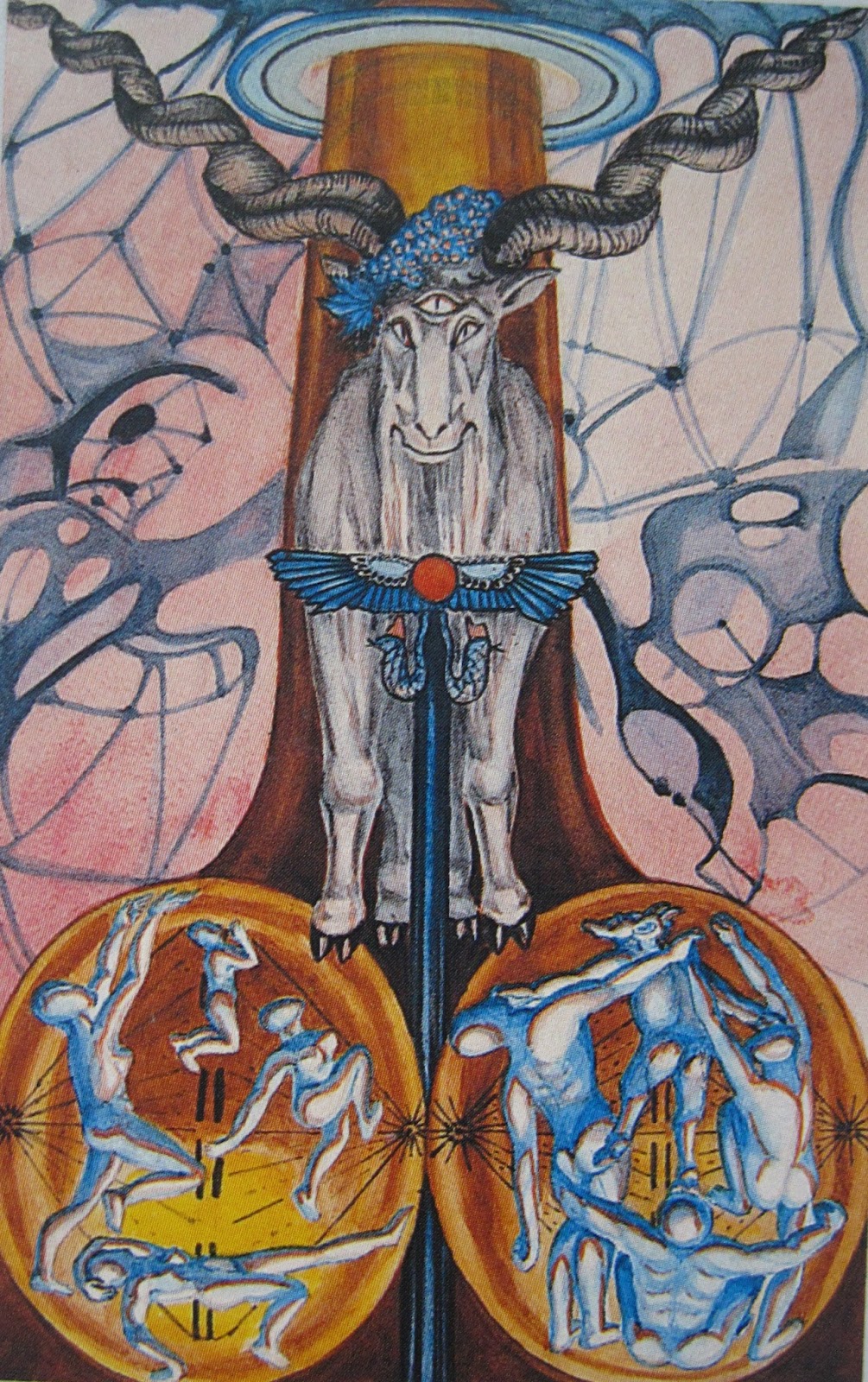
The Devil in Crowley’s Thoth deck always makes me laugh – who can resist that wicked grin of that goat?!  Laughing at how we become imprisoned by our desires and obsessions...and those twisted horns remind me of the twisted sense of humour... There’s an emphasis here on the procreative energy, too, with a very obvious phallic symbol taking centre-stage.


The Devil (trimmed):
© Sharman-Burke/Caselli Tarot
These images are quite different from the more traditional depictions of The Devil, yet the messages are similar. Juliet Sharman-Burke talks about “power and energy imprisoned”, the Devil-goat in the image symbolizing the material world, to which the figures have voluntarily chained themselves – there are chains around their necks but those chains aren’t right, and the figures’ hands are not restricted at all.  I see Saturn, the ruler of Capricorn, coming into play here – those figures show no indication of wanting to make any change, to escape the restrictions they’ve placed on themselves.  Sharman-Burke goes on to say “The Devil refers to all that is dark within your own psyche. That is why we like to think of The Devil’s abode as deep within the bowels of the earth in a place so safely removed from us that we do not have to deal with him. However, such an attitude also means that we live in fear of The Devil, and remain chained to his block of inhibition, restricted because we cannot face the truth about ourselves.”  (The Beginner’s Guide to the Tarot, Juliet Sharman-Burke, Connections 2001)

XV The Devil (trimmed):
© Shadowscapes Tarot
In the Shadowscapes deck, Stephanie Pui-Mun Law gives us a much more ethereal view of The Devil, but we still see that figure seemingly imprisoned – yet not allowing herself to see that there’s an obvious way out. Rather than choose to see the beauty around her, she hides her eyes – what is it she’s so afraid of? The Devil dances above her, laughing at how easy it is to keep what should be a vibrant creature a prisoner – a prisoner of her own fears.


So The Devil acts as a reminder to free ourselves of those restrictions we placed on ourselves and surrender to earthy sensuality (which, as a double Taurus, I shouldn’t have any problems with!) and to meet those who would ‘demonize’ us and what we believe in with humour!


If you’ve enjoyed this post, you might be interested in my e-book, Astrology in Tarot, now available from Amazon.


Beginner’s Guide to the Tarot created by Juliet Sharman-Burke, illustrated by Giovanni Caselli, published by Connections
Druid Craft Tarot created by Philip Carr-Gomm and Stephanie Carr-Gomm, illustrated by Will Worthington, published by Connections
Haindl Tarot, created by Hermann Haindl, published by U.S. Games Systems, Inc.
Shadowscapes Tarot created by Stephanie Pui-Mun Law and Barbara Moore, published by Llewellyn
Thoth Tarot created by Aleister Crowley, illustrated by Lady Frieda Harris, published by U.S. Games Systems, Inc.


Tuesday, 26 December 2017

Capricorn in the Minor Arcana: The Two of Pentacles

Of all the cards in the tarot that have associations with Capricorn (in the system of correspondences that I follow), the one that seems most appropriate for my last blog of 2017 is the Two of Pentacles, linked to the first ten days of Capricorn. Why? Because the association I use is that of Jupiter in Capricorn.  Big, expansive, benevolent Jupiter – in the cardinal, initiating, down-to-earth, practical sign of the sea-goat... Just what we need as we approach a new year: sea-change.

Jupiter in Capricorn symbolizes looking to expand and grow through hard work. Self-discipline will be required in order make progress – which will be steady but sure.  There’s plenty of optimism around, as long as the Saturnian side of Capricorn (remember this sign is ruled by Saturn) isn’t allowed to constrict that expansive faith and confidence by becoming too serious or fearful.  The faith and optimism of Jupiter here is rooted in reality and experience – while the opportunities for change and development come through reliability, sense of responsibility, and patience.

Two of Pentacles (trimmed):
© Universal Waite Tarot
So how might this play out in the Two of Pentacles?  Let’s start with a relatively ‘traditional’ depiction of this card – as illustrated here by the Universal Waite deck. Here we see the familiar figure juggling two pentacles.  Keeping things up in the air, keeping things moving, allowing for change and fluctuation.  The ships, representing fortune (Jupiter also being associated with luck and fortune), are making steady progress through choppy but not life-threatening waves.  And the lemniscate, the symbol for infinity (from the Latin lemniscus, meaning ‘ribbon’), surrounding the two pentacles in the RWS version reminds us that the only constant is change!

Two of Pentacles (trimmed):
© Shadowscapes Tarot
The Shadowscapes deck gives us a more 'ethereal' image to work with, but the idea of juggling, keeping things moving, is still there.  The dragon or iguana or lizard, however you see it, on which the juggler stands, to me is a symbol of fire - you need to keep the fires burning in order for gas to expand (thinking here of Jupiter as one of the 'hot gas' planets).  Heat (in terms of temperature) is also part of the equation of state or thermodynamic equation...without delving too much into the science, I see this as a reminder that fire (Jupiter) is needed to make things happen (Capricorn)!

Two of Stones (trimmed):
© Wildwood Tarot
Then there's the Wildwood Tarot. Although not created with astrology in mind, we can still see the need to keep a balance between things, even when sparring! It requires a firm base to stand on, so that we feel grounded, as well as a willingness to fight to establish ourselves - that's the link to Capricorn. Through that hard work, new possibilities and opportunities open up - for both hares. 


Two of Disks (trimmed):
© Thoth Tarot
One of my favourite versions of this card comes from the Thoth deck. The serpent is coiled in the shape of the lemniscates, which we also see in the pattern of the juggled pentacles in the Rider-Waite-Smith deck.  In the loops formed by the coils, we see the yin and yang symbols, representing balance and harmony - and both internal and external change - which will bring the stability and security so important to Capricorn.  The boundless optimism of Jupiter initiating change for the better - good fortune, health, stability, and harmony ... a great message as we move into the new year! 


Shadowscapes Tarot created by Stephanie Pui-Mun Law and Barbara Moore, published by Llewellyn
Thoth Tarot created by Aleister Crowley, illustrated by Lady Frieda Harris, published by U.S. Games Systems, Inc.
Universal Waite Tarot created by Mary Hanson-Roberts & Pamela Colman-Smith, published by U.S. Games Systems, Inc.
Wildwood Tarot created by Mark Ryan and John Matthews, illustrated by Will Worthington, published by Connections