Showing posts with label Crowley. Show all posts

Friday, 12 January 2018

Capricorn in the Minor Arcana: The Four of Pentacles

Moving on from the Three of Pentacles and that sense of initial completion – the result of patient, disciplines planning – we come to the Four.  We’ve progressed from the expansiveness and benevolence of Jupiter, in the Two, through the determination and drive of Mars in the Three, into the power of the Sun – all in Capricorn. 

Four of Pentacles (trimmed):
© Sharman-Burke/Caselli Tarot
The Sun in Capricorn conjures up a sense of creative energy being “coloured” by discipline and tradition – a single-mindedness, perhaps, working towards a well-defined target. Whatever that target or goal is, it’s going to be about being able to express ourselves and our creativity, but in a responsible way. On the downside, pessimism and cynicism can stand in the way of progress.  We might also find ourselves overly concerned with ‘how things look’, or wanting to hold on to what we have.  Either way, the Sun in Capricorn can represent a strong commitment to the material things in life – be they possessions and/or resources.


Four of Disks (trimmed):
© Thoth Tarot
We see this in the Four of Pentacles, which often symbolizes a fear of letting go, especially in terms of material things.  We may need to be reminded that although nothing is lost if we hold on to what we have, we may not gain anything either – we run the risk of stifling the flow of energy, instead of letting things run their natural course. The expansion that Jupiter promised in the Two could be hindered through our fear of ‘what might happen’ – the ‘what ifs’.


In the Thoth Tarot, the word that Crowley chose for the card is ‘Power’ – the strength of the Sun in a strong, steady, determined Earth sign. It’s grounded. Just look at the image – a fortress, firmly anchored in four corners. Squares are solid, stable, powerful structures; it’s hard to move them, so there’s a sense of protection here, but also of rigidity. The solidity of the structure reflects our own integrity, but also reminds us of the danger of inflexibility and the inability to compromise.

Four of Coins (trimmed):
© Margarete Petersen Tarot
In Margarete Petersen’s Four of Coins cards we also see the square-bounded enclosure, reminiscent of the Crowley version: providing structure, or (on the shadow side) boxing us in.  

The serpent (seen in both the Thoth's and Petersen's Two of Disks) is back, too, forming a complete enclosed area too - an ouroboros, constantly re-creating itself. The solidity of the structure and the strength of the ouroboros reflect our own integrity, but we have to remember the danger of inflexibility and the inability to compromise.  Nothing ventured, nothing gained!

Treasure held safely
within strong walls - but is it
still accessible?


The Four of Pentacles is also linked to the final ten days of Capricorn – from the 10th of January to the early hours of the 20th, when we move into Aquarius...


Beginner’s Guide to the Tarot created by Juliet Sharman-Burke, illustrated by Giovanni Caselli, published by Connections
Margarete Petersen Tarot, AGM-URANIA/Deep Books, 2004.
Thoth Tarot created by Aleister Crowley, illustrated by Lady Frieda Harris, published by U.S. Games Systems, Inc.


Monday, 1 January 2018

Capricorn in the Major Arcana – The Devil!

Happy New Year!

Carrying on with our exploration of Capricorn, we come now to The Devil – but why? What’s the link between the two?

XV Cernunnos (trimmed):
© Druid Craft Tarot
Well, goats have come to symbolize sexuality in many mythologies – for instance, Pan, the Greek goat-god, who was linked to the idea of ‘wild desire’.  In northern European traditions, we have the Horned God, or the Celtic Cernunnos, representing nature and sensuality. Throughout the ages, though, the goat has also become almost synonymous with the Devil, supposedly representing temptation and giving in to our desires.   With Capricorn being an Earth sign, the references to sensuality and physical desire can be extended to material desires. So when we come across the Devil in the tarot, we’re reminded about what’s overpowering or obsessive, the things we try to suppress or deny. It can represent not only temptation, but also surrender – and reminds us that we have the power within us to keep our feet on the ground! 

XV The Devil (trimmed):
© Haindl Tarot
Hermann Haindl’s depiction of the Devil shows both a goat, the traditional Capricorn image, and a serpent. Rachel Pollack, in her Haindl Tarot: A Reader’s Handbook (published by Llewellyn, 2005), talks about kundalini energy being raised by both creatures, through the spirals of the goat’s horns and the coils of the serpent. 

XV The Devil (trimmed):
© Thoth Tarot
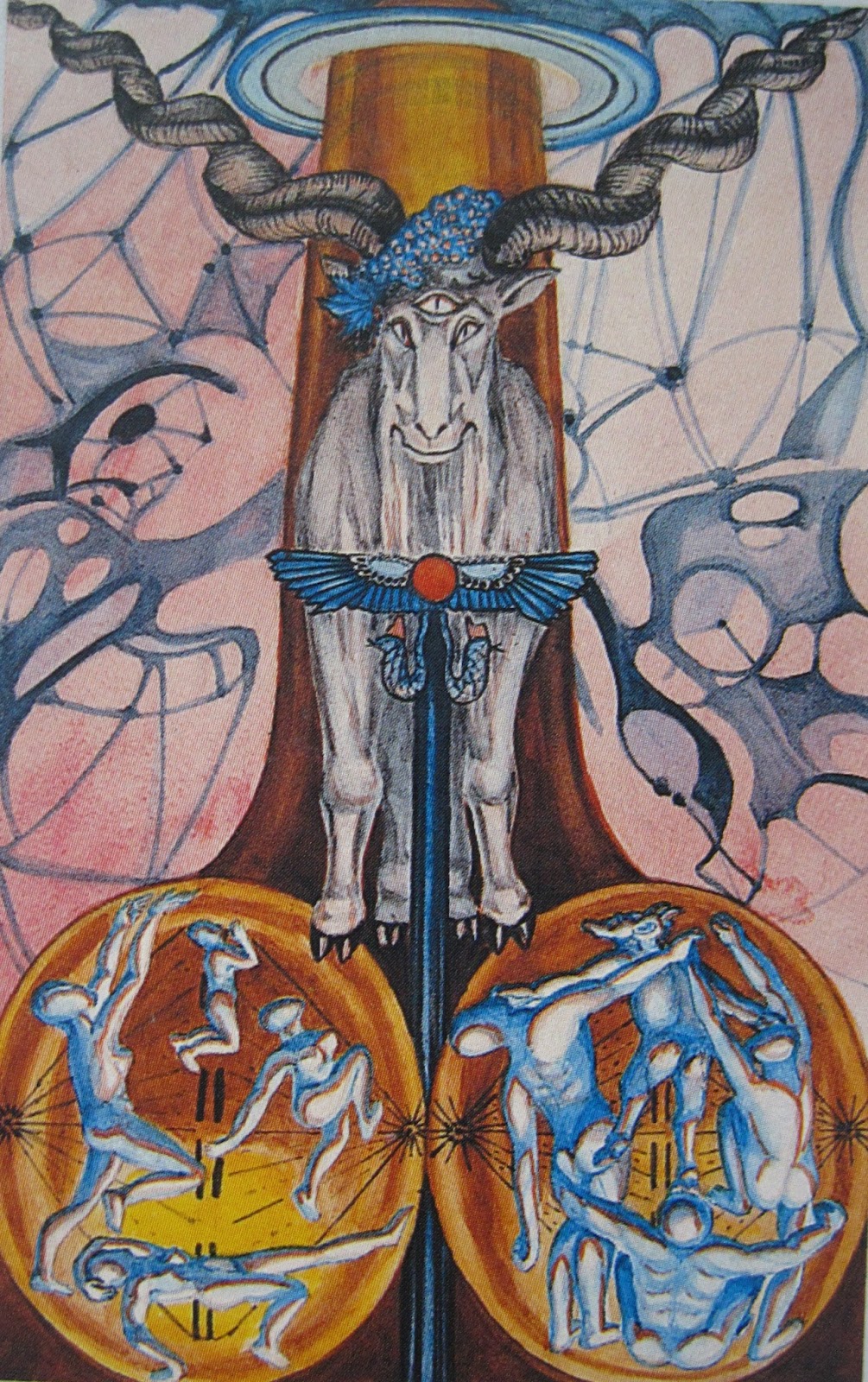
The Devil in Crowley’s Thoth deck always makes me laugh – who can resist that wicked grin of that goat?!  Laughing at how we become imprisoned by our desires and obsessions...and those twisted horns remind me of the twisted sense of humour... There’s an emphasis here on the procreative energy, too, with a very obvious phallic symbol taking centre-stage.


The Devil (trimmed):
© Sharman-Burke/Caselli Tarot
These images are quite different from the more traditional depictions of The Devil, yet the messages are similar. Juliet Sharman-Burke talks about “power and energy imprisoned”, the Devil-goat in the image symbolizing the material world, to which the figures have voluntarily chained themselves – there are chains around their necks but those chains aren’t right, and the figures’ hands are not restricted at all.  I see Saturn, the ruler of Capricorn, coming into play here – those figures show no indication of wanting to make any change, to escape the restrictions they’ve placed on themselves.  Sharman-Burke goes on to say “The Devil refers to all that is dark within your own psyche. That is why we like to think of The Devil’s abode as deep within the bowels of the earth in a place so safely removed from us that we do not have to deal with him. However, such an attitude also means that we live in fear of The Devil, and remain chained to his block of inhibition, restricted because we cannot face the truth about ourselves.”  (The Beginner’s Guide to the Tarot, Juliet Sharman-Burke, Connections 2001)

XV The Devil (trimmed):
© Shadowscapes Tarot
In the Shadowscapes deck, Stephanie Pui-Mun Law gives us a much more ethereal view of The Devil, but we still see that figure seemingly imprisoned – yet not allowing herself to see that there’s an obvious way out. Rather than choose to see the beauty around her, she hides her eyes – what is it she’s so afraid of? The Devil dances above her, laughing at how easy it is to keep what should be a vibrant creature a prisoner – a prisoner of her own fears.


So The Devil acts as a reminder to free ourselves of those restrictions we placed on ourselves and surrender to earthy sensuality (which, as a double Taurus, I shouldn’t have any problems with!) and to meet those who would ‘demonize’ us and what we believe in with humour!


If you’ve enjoyed this post, you might be interested in my e-book, Astrology in Tarot, now available from Amazon.


Beginner’s Guide to the Tarot created by Juliet Sharman-Burke, illustrated by Giovanni Caselli, published by Connections
Druid Craft Tarot created by Philip Carr-Gomm and Stephanie Carr-Gomm, illustrated by Will Worthington, published by Connections
Haindl Tarot, created by Hermann Haindl, published by U.S. Games Systems, Inc.
Shadowscapes Tarot created by Stephanie Pui-Mun Law and Barbara Moore, published by Llewellyn
Thoth Tarot created by Aleister Crowley, illustrated by Lady Frieda Harris, published by U.S. Games Systems, Inc.


Wednesday, 27 September 2017

Libra in the Major Arcana: Justice

Libra is one of the three Air signs, along with Gemini and Aquarius, as well as being one of the cardinal signs.   As such, its energy focuses on the outer world, rather than our inner world, and its main thrust is on social contact.  It seeks partnership – friendship, business, marriage.  It’s not about the passion of a personal relationship – Libra is not thought to be a passionate sign - but more about the ‘contract’, if you like – the need for equality and fairness within relationship.  Libra is the peacemaker, the negotiator, the mediator.  It’s ruled by Venus, providing a sense of refinement, and an awareness of beauty and harmony.

As usual, let’s start our exploration of Libra in the tarot with the Major Arcana.  In my previous post, I mentioned the idea of balance in various traditions – Egyptian and Greek mythology, Christianity – all of which use scales to symbolize the weighing up of whatever’s ‘in the balance’.  That, and the use of the blindfold in some of the imagery, leads us to the Justice card. 

Justice (trimmed):
© Sharman-Burke/Caselli Tarot
Depending on which deck you use, this is probably either the eighth or the eleventh card in the Major Arcana.  Most (but not all) Rider-Waite-Smith-based decks will have Justice as XI in the Major Arcana – the mid-point of the Fool’s Journey.  Personally, I like the idea of it being the 11th card; having it as the fulcrum of the journey, half-way between the start and the end ‘embodies’ that sense of balance.

Some RWS-based decks (for instance Juliet Sharman-Burke and Gionvanni Caselli’s, shown here) place Justice at VIII.   I haven’t found a clear reason for this in the case of the Sharman-Caselli deck, but my guess is that it’s because they wanted to have all four virtues appear in order: 8 – Justice, 9 – Temperance, 10 –Strength, and 11 - The Hermit, the card to which they attribute the virtue of Prudence.  Regardless of the card’s position in the Major Arcana, the image contains most of the ‘traditional’ (i.e. RWS-based) symbolism – the scales representing perfect balance in one hand, the sword of truth in the other.

Libra has a reputation (unfair, in my opinion!) for being indecisive. Following from Virgo’s need to analyze everything in great detail, Libra weighs it all carefully but is always having to take new factors into account, upsetting that delicate balance, hence appearing to be constantly changing its mind.  For this reason, my favourite version of the tarot card associated with Libra, Justice, comes from the Thoth deck (although Crowley has re-named the card ‘Adjustment’). 

Adjustment VIII (trimmed):
© Thoth Tarot
Like many versions of the Justice card, the image still shows a figure with a set of scales, although here the scales appear to be balanced on her head.  She holds the sword of truth in both hands, between her legs, while balancing on her toes. The entire image of one of balance and harmony – including the coloured spheres (blue for spirit and intellect, green for creativity) in their symmetrical placement. But how long can this balance be held?  All it takes is one distraction, one thought, one new factor, to be added to the scales, and the whole thing is no longer balanced.  So it’s not that Libra is indecisive per se – it’s more that that the picture isn’t static; there’s always something else that needs to be considered, something else to knock us off track. That’s why I like the name ‘Adjustment’ – we’re always having to make adjustments as new elements come into play, in order to maintain our (always precarious) balance!

As our ingress into Libra is also marked by the Autumn Equinox, let’s also look at cards that are associated with this festival.  One deck that uses the Wheel of the Year as its base, rather than astrological associations, is the Wildwood Tarot, created by Mark Ryan and John Matthews, and beautifully illustrated by Will Worthington.  Here we have two cards from the Major Arcana that sit at the Autumn Equinox – The Wheel (X) and The Mirror (XII). 
The Wheel (trimmed):
© Wildwood Tarot

The Wheel reminds us of the constantly changing seasons, and that what comes around, goes around.  The equinox is but a moment in time – one where the hours of day and night are balanced, before the hours of darkness increase at the expense of the light.  In many traditions, the autumnal equinox marks the start of a period of withdrawal - not just in terms of physical withdrawal or hibernation - but a time of introspection and inner journeying, contemplation and rest. 

The Mirror (trimmed):
© Wildwood Tarot
The Mirror shows us our reflection and allows us to see our inner selves, and by sitting on the Equinox represents the point at which our journey changes direction – from outer to inner; the point where we’re balanced between the two.  And although Mark Ryan and John Matthews aren’t making any astrological associations in their deck, the mirror is often used as to symbolize Libra. Both through Venus’ rulership and its affinity to the 7th house, Libra is concerned with attraction and partnership.  Aries, the sign opposite Libra in the zodiac, is about ‘I’: -how we meet the world as individuals, how we’re seen. Libra is concerned with ‘the other’ - what we look for in our relationships with others.  The mirror allows us to see what others see in us. ‘Mirror, mirror, on the wall, who is the fairest of them all?’ indeed!

If you’ve enjoyed this post, you might be interested in my new e-book, Astrology in Tarot, now available from Amazon.

Beginner’s Guide to the Tarot created by Juliet Sharman-Burke, illustrated by Giovanni Caselli, published by Connections
Thoth Tarot created by Aleister Crowley, illustrated by Lady Frieda Harris, published by US Games Systems, Inc.

Wildwood Tarot created by Mark Ryan and John Matthews, illustrated by Will Worthington, published by Connections.