Showing posts with label Major Arcana. Show all posts

Sunday, 4 November 2018

Scorpio in the Major Arcana: Death (part 1)

Given what we know of Scorpio, it probably comes as no surprise that the card associated with Scorpio (in the system I follow) is Death. Death, as in the end of a cycle – something that’s necessary in order to allow something new to grow and develop. Not physical death, or at least, not necessarily. 
Death (trimmed):
© Sharman-Burke/Caselli Tarot

Traditional depictions of Death show us a knight in armour on a white horse, a king dead underfoot, a religious figure in its path, sometimes children. The image in the Sharman-Burke/Caselli tarot is a variation on that theme; here the horse is black (the colour associated with death in some cultures), its rider a skeleton. The skeleton’s headdress is a swaddling cloth, used at birth, reflecting the link between birth and death and the unending cycle of life. The skeleton carries an hourglass, reminding us that everything has its time. 


In the distance, we see a river – another reminder of the ongoing process of transformation, this time in the form of the hydrologic cycle (the river water evaporates and forms clouds, the clouds rain, rainwater falls back to earth). The boat is said to symbolize both the cradle and the coffin. In the foreground we see a raven, thought to be a harbinger of death in many traditions. The theme is Scorpionic – transformation and change; endings creating openings for new beginnings.


XIII Death (trimmed):
© Thoth Tarot
The skeleton with his scythe are also seen in the Crowley Thoth tarot’s version of Death. He wears two faces here – one is that of the destroyer, the other that of the liberator – reminding us that in order to change, we may have to let go of things that hold us back, that no longer serve us. The headdress of this skeleton is a funereal head-covering, used in ancient Egypt – a reminder of the need to bury old, out-dated, invalid ideas and beliefs so that new life can begin. We see the scorpion at the bottom of the image, ready to sting, and the snake – perhaps THE symbol of transformation – ready to bite. A fish, representing the past, swims through the serpent’s coils: is it the next victim? Above it all, the phoenix, which can only rise from the ashes once the fire has consumed everything in its way. Intense? Oh yes! 


Beginner’s Guide to the Tarot created by Juliet Sharman-Burke, illustrated by Giovanni Caselli, published by Connections
Thoth Tarot created by Aleister Crowley, illustrated by Lady Frieda Harris, published by U.S. Games Systems, Inc.


Monday, 1 January 2018

Capricorn in the Major Arcana – The Devil!

Happy New Year!

Carrying on with our exploration of Capricorn, we come now to The Devil – but why? What’s the link between the two?

XV Cernunnos (trimmed):
© Druid Craft Tarot
Well, goats have come to symbolize sexuality in many mythologies – for instance, Pan, the Greek goat-god, who was linked to the idea of ‘wild desire’.  In northern European traditions, we have the Horned God, or the Celtic Cernunnos, representing nature and sensuality. Throughout the ages, though, the goat has also become almost synonymous with the Devil, supposedly representing temptation and giving in to our desires.   With Capricorn being an Earth sign, the references to sensuality and physical desire can be extended to material desires. So when we come across the Devil in the tarot, we’re reminded about what’s overpowering or obsessive, the things we try to suppress or deny. It can represent not only temptation, but also surrender – and reminds us that we have the power within us to keep our feet on the ground! 

XV The Devil (trimmed):
© Haindl Tarot
Hermann Haindl’s depiction of the Devil shows both a goat, the traditional Capricorn image, and a serpent. Rachel Pollack, in her Haindl Tarot: A Reader’s Handbook (published by Llewellyn, 2005), talks about kundalini energy being raised by both creatures, through the spirals of the goat’s horns and the coils of the serpent. 

XV The Devil (trimmed):
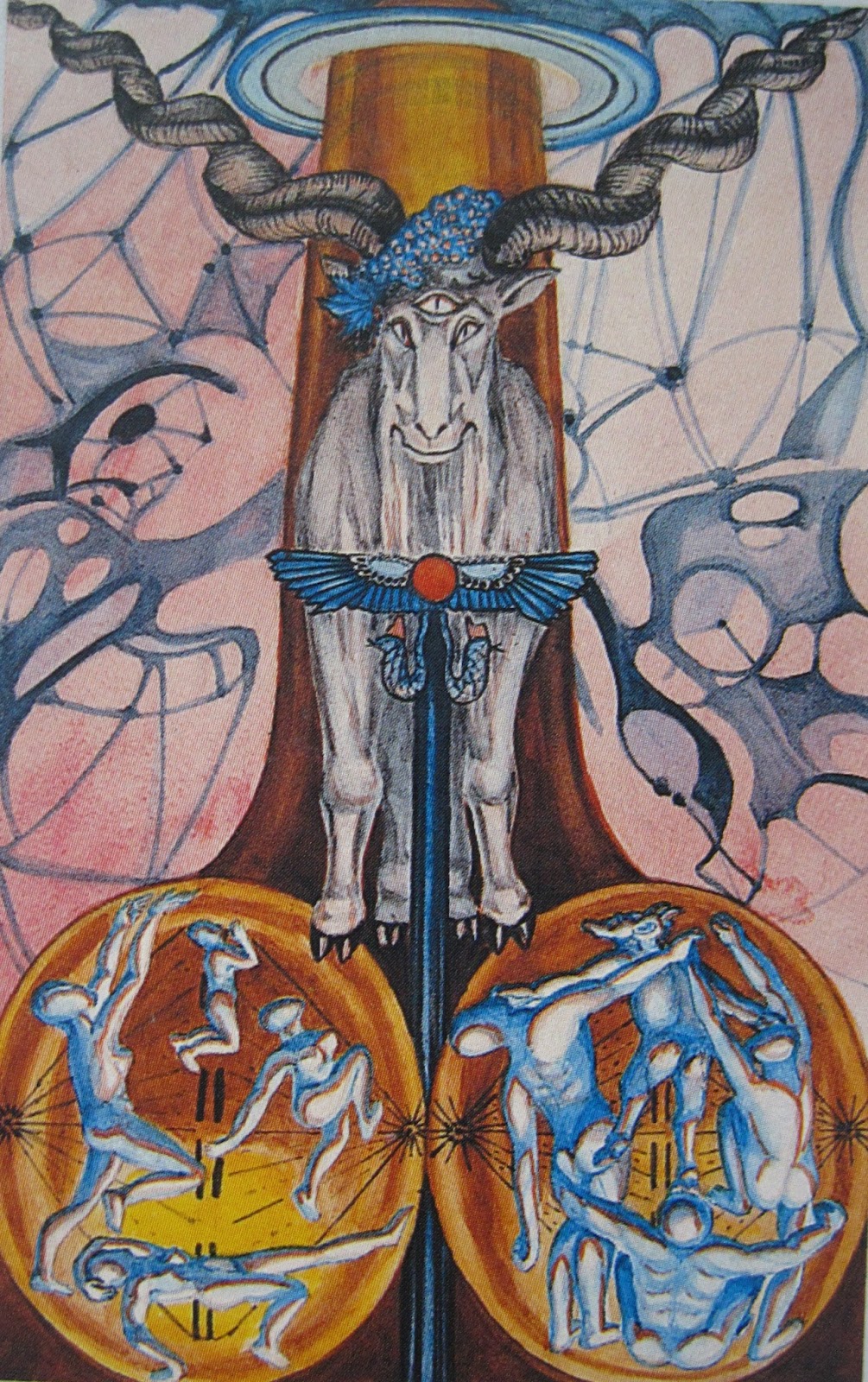
© Thoth Tarot
The Devil in Crowley’s Thoth deck always makes me laugh – who can resist that wicked grin of that goat?!  Laughing at how we become imprisoned by our desires and obsessions...and those twisted horns remind me of the twisted sense of humour... There’s an emphasis here on the procreative energy, too, with a very obvious phallic symbol taking centre-stage.


The Devil (trimmed):
© Sharman-Burke/Caselli Tarot
These images are quite different from the more traditional depictions of The Devil, yet the messages are similar. Juliet Sharman-Burke talks about “power and energy imprisoned”, the Devil-goat in the image symbolizing the material world, to which the figures have voluntarily chained themselves – there are chains around their necks but those chains aren’t right, and the figures’ hands are not restricted at all.  I see Saturn, the ruler of Capricorn, coming into play here – those figures show no indication of wanting to make any change, to escape the restrictions they’ve placed on themselves.  Sharman-Burke goes on to say “The Devil refers to all that is dark within your own psyche. That is why we like to think of The Devil’s abode as deep within the bowels of the earth in a place so safely removed from us that we do not have to deal with him. However, such an attitude also means that we live in fear of The Devil, and remain chained to his block of inhibition, restricted because we cannot face the truth about ourselves.”  (The Beginner’s Guide to the Tarot, Juliet Sharman-Burke, Connections 2001)

XV The Devil (trimmed):
© Shadowscapes Tarot
In the Shadowscapes deck, Stephanie Pui-Mun Law gives us a much more ethereal view of The Devil, but we still see that figure seemingly imprisoned – yet not allowing herself to see that there’s an obvious way out. Rather than choose to see the beauty around her, she hides her eyes – what is it she’s so afraid of? The Devil dances above her, laughing at how easy it is to keep what should be a vibrant creature a prisoner – a prisoner of her own fears.


So The Devil acts as a reminder to free ourselves of those restrictions we placed on ourselves and surrender to earthy sensuality (which, as a double Taurus, I shouldn’t have any problems with!) and to meet those who would ‘demonize’ us and what we believe in with humour!


If you’ve enjoyed this post, you might be interested in my e-book, Astrology in Tarot, now available from Amazon.


Beginner’s Guide to the Tarot created by Juliet Sharman-Burke, illustrated by Giovanni Caselli, published by Connections
Druid Craft Tarot created by Philip Carr-Gomm and Stephanie Carr-Gomm, illustrated by Will Worthington, published by Connections
Haindl Tarot, created by Hermann Haindl, published by U.S. Games Systems, Inc.
Shadowscapes Tarot created by Stephanie Pui-Mun Law and Barbara Moore, published by Llewellyn
Thoth Tarot created by Aleister Crowley, illustrated by Lady Frieda Harris, published by U.S. Games Systems, Inc.


Thursday, 5 November 2015

Scorpio in the Druidcraft Major Arcana


After dipping into the Minor Arcana – and the excitement of the Samhain Tarot Blog Hop! - let’s look at Scorpio in the Major Arcana.  Given what we know of Scorpio, it probably comes as no surprise that the card associated with Scorpio (in the system I follow) is ‘Death’.  Death, as in the end of a cycle – something that’s necessary in order to allow something new to grow and develop; transformation.  Not physical death, or at least, not necessarily.  
 
Traditional depictions of ‘Death’, number 13 in the Rider-Waite-Smith tarot, show us a knight in armour on a white horse, a king dead underfoot, a religious figure in its path, sometimes children.  The Druidcraft uses different symbolism in its image.
Death (detail): Druidcraft Tarot

Here we see the Cailleach (the ‘crone’ aspect of the Goddess) and her cauldron of rebirth. The flames beneath it symbolize the transforming power of fire – it transforms water to steam, for instance.  In the background we see a dolmen, a place of burial, but also a place of initiation and rebirth – which is also reflected in the approaching dawn on the horizon. An adder watches her from its cranny, representing death as transformation, the shedding of the skin, rather than as the ‘end’.

The creators of the deck, Philip and Stephanie Carr-Gomm, write in the accompanying book that this card “does not convey a sense of hopelessness but instead hints at the potential that death offers for transformation and rebirth”. I agree with this, and feel that it conveys the intense power associated  with the (re)cycling of life through death and birth; all 8th house-Scorpio issues.


Druidcraft Tarot created by Philip Carr-Gomm and Stephanie Carr-Gomm, illustrated by Will Worthington, published by Connections

Wednesday, 28 January 2015

Aquarius in the Major Arcana - The Star


'Ganymede' (juzzodiac.tmblr.com)

Let’s continue our exploration of Aquarius in the tarot with the Major Arcana. We already know that it combines the element of air with fixed energy, making it a very ‘in your head’ sign.   It’s associated with ideology and reform, humanitarianism and working with community and groups.  In Greek mythology, Ganymede was the cup-bearer to the gods, serving them with the nectar or ambrosia which gave them immortality – and was placed in the heavens as the constellation Aquarius as his reward.  The contents of that cup were life-sustaining – and what is it that sustains us, more often than not? Hope. And what card in the Major Arcana could we connect with hope? The Star!

Sharman-Caselli Tarot
Traditional depictions of The Star show us a young, naked woman with two pitchers of water – a water carrier.  Her youth is said to symbolize renewal, while her nakedness represents truth for all to see.  In the Sharman-Caselli version, she has one foot on land (past) and the other in water (the future), linking the two - and perhaps also linking the conscious and unconscious.  The foot in water also links us to the Pool of Memory, allowing us to remember events that give us hope, that sustain us.  Her two water jugs sustain both the land and the pool. See too how the water on the land separates into five streams, symbolizing our five senses, before returning to the pool.  Aquarius may be detached, but it can certainly feed us, providing us with hope and optimism – the promise of a new day (dawn).  The card carries the number 17, 1 + 7: there is one large star in the dawn sky, surrounded by seven smaller ones, adding up to eight, the number of re-birth and regeneration – more promise of hope.  

Shadowscapes Tarot
The Shadowscapes Tarot gives us a more ethereal figure. She's not a water carrier in the strictest sense of the word, although both water and air (remember we're talking about Aquarius here) are present in the image - her feet dance in water while the rest of her dances in the air against a backdrop of the Milky Way, representing perhaps the fixedness of this sign (yes, there are some stars that are referred to as 'fixed'!).  According to the creator, in the accompanying Shadowscapes Companion (see details below), "she dances the dance that the stars have choreographed...their silent homage to the burning spirit they have witnessed." So although in reality stars shine with their own light, you could say these ones are reflecting the hope that each person carries!

Wildwood Tarot
Sailors used to, perhaps still do, navigate by the stars at night. The Pole Star is one of the (apparently) ‘fixed’ star in the sky, making it particularly useful in celestial navigation – and therefore a symbol of hope in its own right.   In the Wildwood Tarot, the Pole Star is referred to as a symbol of “universal law, spiritual knowledge and power”. What brings it back to the traditional meaning of the Star, for me, is the idea of universal knowledge being a web – a very Aquarian concept!  

Thoth Tarot
The Thoth uses the Egyptian sky goddess Nuit (also known as Nu, Nut, and Nuith) to depict the water carrier.  Here we get more of a sense of the ideological aspects of Aquarius – Nuit receives inspiration from the universe and allows it to flow through her, passing it on to humanity, or the greater good.  The card represents clarity of vision, which we could associate with the ‘airiness’ of Aquarius, while Nuit appears to be grounded, representing the ‘fixedness’ of the sign.

No surprise that Imbolc occurs during our sojourn in Aquarius – first signs of spring bringing forth hope.The  Imbolc Tarot Blog Hop takes place on 2nd February – watch this space!


Shadowscapes Tarot created by Stephanie Pui-Mun Law and Barbara Moore, published by Llewellyn
Sharman-Caselli Tarot created by Juliet Sharman-Burke, illustrated by Giovanni Caselli, published by Connections
Thoth Tarot created by Aleister Crowley, illustrated by Lady Frieda Harris, published by US Games Systems, Inc.
Wildwood Tarot created by Mark Ryan and John Matthews, illustrated by Will Worthington, published by Connections