Showing posts with label The Devil. Show all posts

Monday, 1 January 2018

Capricorn in the Major Arcana – The Devil!

Happy New Year!

Carrying on with our exploration of Capricorn, we come now to The Devil – but why? What’s the link between the two?

XV Cernunnos (trimmed):
© Druid Craft Tarot
Well, goats have come to symbolize sexuality in many mythologies – for instance, Pan, the Greek goat-god, who was linked to the idea of ‘wild desire’.  In northern European traditions, we have the Horned God, or the Celtic Cernunnos, representing nature and sensuality. Throughout the ages, though, the goat has also become almost synonymous with the Devil, supposedly representing temptation and giving in to our desires.   With Capricorn being an Earth sign, the references to sensuality and physical desire can be extended to material desires. So when we come across the Devil in the tarot, we’re reminded about what’s overpowering or obsessive, the things we try to suppress or deny. It can represent not only temptation, but also surrender – and reminds us that we have the power within us to keep our feet on the ground! 

XV The Devil (trimmed):
© Haindl Tarot
Hermann Haindl’s depiction of the Devil shows both a goat, the traditional Capricorn image, and a serpent. Rachel Pollack, in her Haindl Tarot: A Reader’s Handbook (published by Llewellyn, 2005), talks about kundalini energy being raised by both creatures, through the spirals of the goat’s horns and the coils of the serpent. 
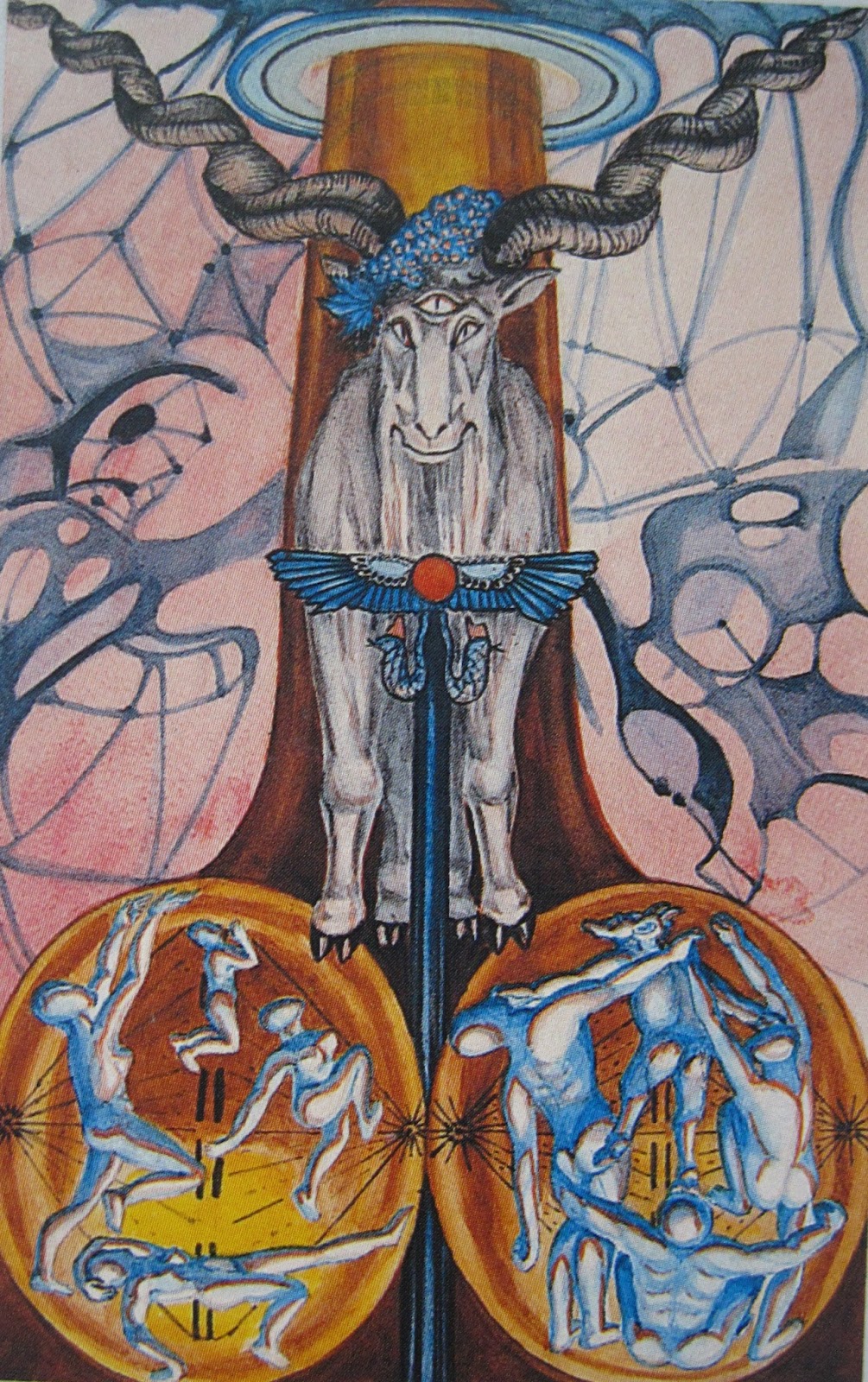
XV The Devil (trimmed):
© Thoth Tarot
The Devil in Crowley’s Thoth deck always makes me laugh – who can resist that wicked grin of that goat?!  Laughing at how we become imprisoned by our desires and obsessions...and those twisted horns remind me of the twisted sense of humour... There’s an emphasis here on the procreative energy, too, with a very obvious phallic symbol taking centre-stage.


The Devil (trimmed):
© Sharman-Burke/Caselli Tarot
These images are quite different from the more traditional depictions of The Devil, yet the messages are similar. Juliet Sharman-Burke talks about “power and energy imprisoned”, the Devil-goat in the image symbolizing the material world, to which the figures have voluntarily chained themselves – there are chains around their necks but those chains aren’t right, and the figures’ hands are not restricted at all.  I see Saturn, the ruler of Capricorn, coming into play here – those figures show no indication of wanting to make any change, to escape the restrictions they’ve placed on themselves.  Sharman-Burke goes on to say “The Devil refers to all that is dark within your own psyche. That is why we like to think of The Devil’s abode as deep within the bowels of the earth in a place so safely removed from us that we do not have to deal with him. However, such an attitude also means that we live in fear of The Devil, and remain chained to his block of inhibition, restricted because we cannot face the truth about ourselves.”  (The Beginner’s Guide to the Tarot, Juliet Sharman-Burke, Connections 2001)

XV The Devil (trimmed):
© Shadowscapes Tarot
In the Shadowscapes deck, Stephanie Pui-Mun Law gives us a much more ethereal view of The Devil, but we still see that figure seemingly imprisoned – yet not allowing herself to see that there’s an obvious way out. Rather than choose to see the beauty around her, she hides her eyes – what is it she’s so afraid of? The Devil dances above her, laughing at how easy it is to keep what should be a vibrant creature a prisoner – a prisoner of her own fears.


So The Devil acts as a reminder to free ourselves of those restrictions we placed on ourselves and surrender to earthy sensuality (which, as a double Taurus, I shouldn’t have any problems with!) and to meet those who would ‘demonize’ us and what we believe in with humour!


If you’ve enjoyed this post, you might be interested in my e-book, Astrology in Tarot, now available from Amazon.


Beginner’s Guide to the Tarot created by Juliet Sharman-Burke, illustrated by Giovanni Caselli, published by Connections
Druid Craft Tarot created by Philip Carr-Gomm and Stephanie Carr-Gomm, illustrated by Will Worthington, published by Connections
Haindl Tarot, created by Hermann Haindl, published by U.S. Games Systems, Inc.
Shadowscapes Tarot created by Stephanie Pui-Mun Law and Barbara Moore, published by Llewellyn
Thoth Tarot created by Aleister Crowley, illustrated by Lady Frieda Harris, published by U.S. Games Systems, Inc.


Thursday, 12 January 2017

The Devil in Margarete Petersen’s tarot

The Devil (trimmed):© Margarete Petersen Tarot
Margarete Petersen’s Devil is, with Magic, my co-favourite card of the Majors.  A world away from the RWS crouching demon, for sure. I see a multi-faceted jewel, a diamond perhaps, with figures trapped within facets. The face of ‘the Devil’ is also present, at the tip of the jewel. 
Try as I might, I can't see a goat in there! (This card is linked to Capricorn, astrologically.)
Although the facets contain figures, they also represent the ability to shift perspective, I think – like looking at a prism from different angles and seeing the changes in the refracted colours/light. Not unlike the Capricorn goat, having to change direction and find new paths in order to pick his way around the obstacles that lie between him and the top of the mountain.  
The jewel sits in a sea of red ‘waves’ of fire – the passions, desires, that consume us.  MP writes of the “confusion in the passionate flame” – the figures are all topsy-turvy in their quest.  She also writes “In the sharpened vision at the point of brilliance, /New perspectives open”, which sums it all up for me!
I don’t see a right hand raised in benediction here, as in more traditional versions, but I do think there’s a link between the Devil and Hierophant in terms of meaning. One is about working out what to take from the ‘structure’ imposed by culture/society, the other is about working out how not to be enslaved by the trappings of that culture/society.  Ridiculing? Yes, perhaps – the Devil laughs at how easily we fall prey to what we think we need, thanks to the consumerism (and I don’t just mean material) of our society.  No smirking goat in this image but just think of the Thoth's version of The Devil!
Enslaved by desire
Yet unchained, free to escape
Fear and confusion.
 

Margarete Petersen Tarot, AGM-URANIA, 2004. 

Saturday, 2 January 2016

Capricorn in the DruidCraft Major Arcana – Cernunnos and The Devil


Capricorn brings us to The Devil – but why? What’s the link between the two? And why, in the DruidCraft Tarot, do we have Cernunnos representing the Devil?


Let’s start with the two questions – what links Capricorn and the Devil?  Capricorn is often seen as a goat, or part-goat, part-fish (for more on this, see my Capricorn post here). Goats have come to symbolize sexuality in many mythologies – for instance, Pan, the Greek goat-god, who was linked to the idea of ‘wild desire’.  In northern European traditions, we have the Horned God, representing nature and sensuality. Throughout the ages, though, the goat has also become almost synonymous with the Devil, supposedly representing temptation and giving in to our desires.   With Capricorn being an Earth sign, the references to sensuality and physical desire can be extended to material desires. So when we come across the Devil in the tarot, we’re reminded about what’s overpowering or obsessive, the things we try to suppress or deny. It can represent not only temptation, but also surrender – and reminds us that we have the power within us to keep our feet on the ground!  


Cernunnos: DruidCraft Tarot (trimmed)
The creators of the DruidCraft have chosen to break with this tradition, though.  Card XV depicts Cernunnos, the Lord of Animals, the wild Hunter, the Herdsman, the Horned God, standing in a forest grove.  At his feet lie the two lovers we saw in card VI, asleep.


In more traditional images we usually see the Devil-goat symbolizing the material world to which the figures have voluntarily chained themselves – there are chains around their necks but those chains aren’t tight, and the figures’ hands are not restricted. They are not slaves to external forces or events but only to their own desires and illusions.  In choosing to use Cernunnos to represent The Devil, the deck’s creators turn the focus of the card more towards the need to accept responsibility for our instincts and how we act on them - for our desires, be they sexual or material. Yes, there is still a warning again obsession, but by drawing on Cernunnos as representative of the raw force of Nature and our ‘animal’ instincts, they also remind us to respect that force and to be responsible for how we use it, both socially and environmentally.


That’s where I see Capricorn coming into play here.  Capricorn is an Earth sign, so we have both the earthiness of the material and sexual realms represented. It’s also a Cardinal sign – the ‘go-getter’ energy, the initiator. Capricorn stands for integrity (a Saturnian concept, with Saturn being the ruler of Capricorn) as well as ambition - but ambition in a practical, tenacious, business-like sense.  With that comes the ability to take on responsibility, to ensure that respect is paid where it’s due.  On the ‘shadow’ side then, it can appear as greed or lack of respect or integrity.


The creators write, in the accompanying book to this deck, of the need to “integrate and channel” our instincts, this life-force, rather than repress it, so that we can be happy, healthy, and creative in “appropriate and responsible ways” – with Saturnian integrity, in other words. So once again, although this deck was not designed with astrology in mind, I can certainly see how Capricornian qualities relate to Cernunnos in this incarnation as The Devil.

Druidcraft Tarot created by Philip Carr-Gomm and Stephanie Carr-Gomm, illustrated by Will Worthington, published by Connections 2004
 

Friday, 2 January 2015

Capricorn in the Major Arcana – The Devil!

First post of the new year!  I like the idea of starting out with The Devil, the Major Arcana card linked to Capricorn. But what's the link between them?


Cerunnos - Druidcraft Tarot

Goats have come to symbolize sexuality in many mythologies – for instance, Pan, the Greek goat-god, who was linked to the idea of ‘wild desire’.  In northern European traditions, we have the Horned God, representing nature and sensuality. Throughout the ages, though, the goat has also become almost synonymous with the Devil, supposedly representing temptation and giving in to our desires.   With Capricorn being an Earth sign, the references to sensuality and physical desire can be extended to material desires. So when we come across the Devil in the tarot, we’re reminded about what’s overpowering or obsessive, the things we try to suppress or deny. It can represent not only temptation, but also surrender – and reminds us that we have the power within us to keep our feet on the ground!  

Haindl Tarot
Hermann Haindl’s depiction of the Devil shows both a goat, the traditional Capricorn image, and a serpent. Rachel Pollack, in her Haindl Tarot: A Reader’s Handbook, talks about kundalini energy being raised by both creatures, through the spirals of the goat’s horns and the coils of the serpent. 

Thoth Tarot
Crowley’s Thoth deck’s Devil always makes me laugh – who can resist that wicked grin of that goat?!  Laughing at how we become imprisoned by our desires and obsessions...and those twisted horns remind me of the twisted sense of humour... There’s an emphasis here on the procreative energy, too, with a very obvious phallic symbol taking centre stage. 

Sharman-Caselli Tarot
These images are quite different from the more traditional depictions of The Devil, yet the messages are similar. Juliet Sharman-Burke talks about “power and energy imprisoned”, the Devil-goat in the image symbolizing the material world, to which the figures have voluntarily chained themselves – there are chains around their necks but those chains aren’t right, and the figures’ hands are not restricted at all.  I see Saturn, the ruler of Capricorn, coming into play here – those figures show no indication of wanting to make any change, to escape the restrictions they’ve placed on themselves.  

Sharman-Burke goes on to say “The Devil refers to all that is dark within your own psyche. That is why we like to think of The Devil’s abode as deep within the bowels of the earth in a place so safely removed from us that we do not have to deal with him. However, such an attitude also means that we live in fear of The Devil, and remain chained to his block of inhibition, restricted because we cannot face the truth about ourselves.”  (The Beginner’s Guide to the Tarot, Juliet Sharman-Burke, Connections 2001)

Shadowscapes Tarot
In the Shadowscapes deck, Stepanie Pui-Mun Law gives us a much more ethereal view of The Devil, but we still see that figure seemingly imprisoned – yet not allowing herself to see that there’s an obvious way out. Rather than choose to see the beauty around her, she hides her eyes – what is it she’s so afraid of? The Devil dances above her, laughing at how easy it is to keep what should be a vibrant creature a prisoner – a prisoner of her own fears.

So The Devil acts as a reminder to free ourselves of those restrictions we placed on ourselves and surrender to earthy sensuality (which, as a double Taurus, I shouldn’t have any problems with!) and to meet those who would ‘demonize’ us and what we believe in with humour!  Good advice with which to start the new year :-)


Druidcraft Tarot created by Philip Carr-Gomm and Stephanie Carr-Gomm, illustrated by Will Worthington, published by Connections
Haindl Tarot created by Hermann Haindl, published by US Games Systems, Inc.

Shadowscapes Tarot created by Stephanie Pui-Mun Law and Barbara Moore, published by Llewellyn
Sharman-Caselli Tarot created by Juliet Sharman-Burke, illustrated by Giovanni Caselli, published by Connections
Thoth Tarot created by Aleister Crowley, illustrated by Lady Frieda Harris, published by US Games Systems, Inc.