Monday, 1 January 2018

Capricorn in the Major Arcana – The Devil!

Happy New Year!

Carrying on with our exploration of Capricorn, we come now to The Devil – but why? What’s the link between the two?

XV Cernunnos (trimmed):
© Druid Craft Tarot
Well, goats have come to symbolize sexuality in many mythologies – for instance, Pan, the Greek goat-god, who was linked to the idea of ‘wild desire’.  In northern European traditions, we have the Horned God, or the Celtic Cernunnos, representing nature and sensuality. Throughout the ages, though, the goat has also become almost synonymous with the Devil, supposedly representing temptation and giving in to our desires.   With Capricorn being an Earth sign, the references to sensuality and physical desire can be extended to material desires. So when we come across the Devil in the tarot, we’re reminded about what’s overpowering or obsessive, the things we try to suppress or deny. It can represent not only temptation, but also surrender – and reminds us that we have the power within us to keep our feet on the ground! 

XV The Devil (trimmed):
© Haindl Tarot
Hermann Haindl’s depiction of the Devil shows both a goat, the traditional Capricorn image, and a serpent. Rachel Pollack, in her Haindl Tarot: A Reader’s Handbook (published by Llewellyn, 2005), talks about kundalini energy being raised by both creatures, through the spirals of the goat’s horns and the coils of the serpent. 
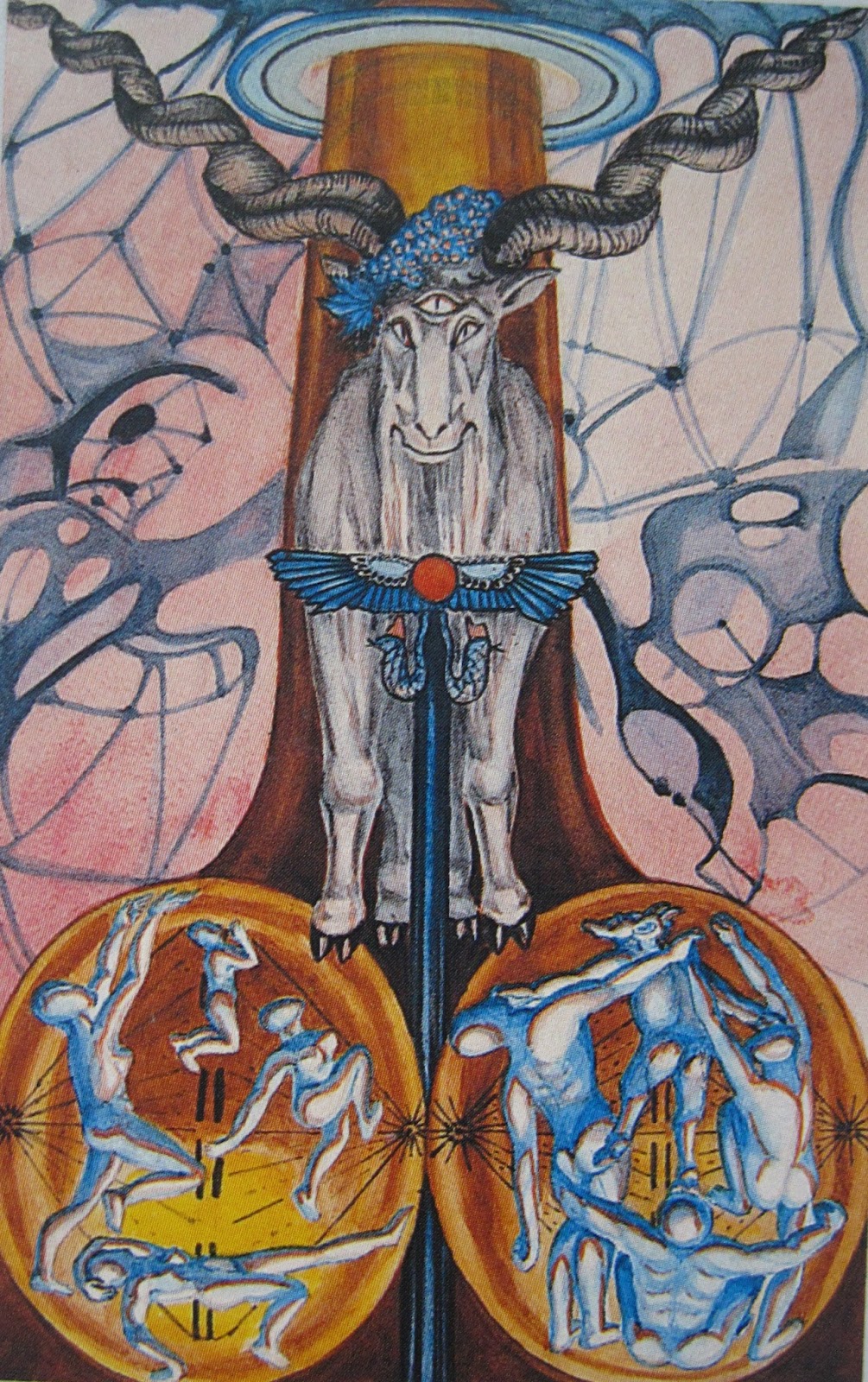
XV The Devil (trimmed):
© Thoth Tarot
The Devil in Crowley’s Thoth deck always makes me laugh – who can resist that wicked grin of that goat?!  Laughing at how we become imprisoned by our desires and obsessions...and those twisted horns remind me of the twisted sense of humour... There’s an emphasis here on the procreative energy, too, with a very obvious phallic symbol taking centre-stage.


The Devil (trimmed):
© Sharman-Burke/Caselli Tarot
These images are quite different from the more traditional depictions of The Devil, yet the messages are similar. Juliet Sharman-Burke talks about “power and energy imprisoned”, the Devil-goat in the image symbolizing the material world, to which the figures have voluntarily chained themselves – there are chains around their necks but those chains aren’t right, and the figures’ hands are not restricted at all.  I see Saturn, the ruler of Capricorn, coming into play here – those figures show no indication of wanting to make any change, to escape the restrictions they’ve placed on themselves.  Sharman-Burke goes on to say “The Devil refers to all that is dark within your own psyche. That is why we like to think of The Devil’s abode as deep within the bowels of the earth in a place so safely removed from us that we do not have to deal with him. However, such an attitude also means that we live in fear of The Devil, and remain chained to his block of inhibition, restricted because we cannot face the truth about ourselves.”  (The Beginner’s Guide to the Tarot, Juliet Sharman-Burke, Connections 2001)

XV The Devil (trimmed):
© Shadowscapes Tarot
In the Shadowscapes deck, Stephanie Pui-Mun Law gives us a much more ethereal view of The Devil, but we still see that figure seemingly imprisoned – yet not allowing herself to see that there’s an obvious way out. Rather than choose to see the beauty around her, she hides her eyes – what is it she’s so afraid of? The Devil dances above her, laughing at how easy it is to keep what should be a vibrant creature a prisoner – a prisoner of her own fears.


So The Devil acts as a reminder to free ourselves of those restrictions we placed on ourselves and surrender to earthy sensuality (which, as a double Taurus, I shouldn’t have any problems with!) and to meet those who would ‘demonize’ us and what we believe in with humour!


If you’ve enjoyed this post, you might be interested in my e-book, Astrology in Tarot, now available from Amazon.


Beginner’s Guide to the Tarot created by Juliet Sharman-Burke, illustrated by Giovanni Caselli, published by Connections
Druid Craft Tarot created by Philip Carr-Gomm and Stephanie Carr-Gomm, illustrated by Will Worthington, published by Connections
Haindl Tarot, created by Hermann Haindl, published by U.S. Games Systems, Inc.
Shadowscapes Tarot created by Stephanie Pui-Mun Law and Barbara Moore, published by Llewellyn
Thoth Tarot created by Aleister Crowley, illustrated by Lady Frieda Harris, published by U.S. Games Systems, Inc.


Tuesday, 26 December 2017

Capricorn in the Minor Arcana: The Two of Pentacles

Of all the cards in the tarot that have associations with Capricorn (in the system of correspondences that I follow), the one that seems most appropriate for my last blog of 2017 is the Two of Pentacles, linked to the first ten days of Capricorn. Why? Because the association I use is that of Jupiter in Capricorn.  Big, expansive, benevolent Jupiter – in the cardinal, initiating, down-to-earth, practical sign of the sea-goat... Just what we need as we approach a new year: sea-change.

Jupiter in Capricorn symbolizes looking to expand and grow through hard work. Self-discipline will be required in order make progress – which will be steady but sure.  There’s plenty of optimism around, as long as the Saturnian side of Capricorn (remember this sign is ruled by Saturn) isn’t allowed to constrict that expansive faith and confidence by becoming too serious or fearful.  The faith and optimism of Jupiter here is rooted in reality and experience – while the opportunities for change and development come through reliability, sense of responsibility, and patience.

Two of Pentacles (trimmed):
© Universal Waite Tarot
So how might this play out in the Two of Pentacles?  Let’s start with a relatively ‘traditional’ depiction of this card – as illustrated here by the Universal Waite deck. Here we see the familiar figure juggling two pentacles.  Keeping things up in the air, keeping things moving, allowing for change and fluctuation.  The ships, representing fortune (Jupiter also being associated with luck and fortune), are making steady progress through choppy but not life-threatening waves.  And the lemniscate, the symbol for infinity (from the Latin lemniscus, meaning ‘ribbon’), surrounding the two pentacles in the RWS version reminds us that the only constant is change!

Two of Pentacles (trimmed):
© Shadowscapes Tarot
The Shadowscapes deck gives us a more 'ethereal' image to work with, but the idea of juggling, keeping things moving, is still there.  The dragon or iguana or lizard, however you see it, on which the juggler stands, to me is a symbol of fire - you need to keep the fires burning in order for gas to expand (thinking here of Jupiter as one of the 'hot gas' planets).  Heat (in terms of temperature) is also part of the equation of state or thermodynamic equation...without delving too much into the science, I see this as a reminder that fire (Jupiter) is needed to make things happen (Capricorn)!

Two of Stones (trimmed):
© Wildwood Tarot
Then there's the Wildwood Tarot. Although not created with astrology in mind, we can still see the need to keep a balance between things, even when sparring! It requires a firm base to stand on, so that we feel grounded, as well as a willingness to fight to establish ourselves - that's the link to Capricorn. Through that hard work, new possibilities and opportunities open up - for both hares. 


Two of Disks (trimmed):
© Thoth Tarot
One of my favourite versions of this card comes from the Thoth deck. The serpent is coiled in the shape of the lemniscates, which we also see in the pattern of the juggled pentacles in the Rider-Waite-Smith deck.  In the loops formed by the coils, we see the yin and yang symbols, representing balance and harmony - and both internal and external change - which will bring the stability and security so important to Capricorn.  The boundless optimism of Jupiter initiating change for the better - good fortune, health, stability, and harmony ... a great message as we move into the new year! 


Shadowscapes Tarot created by Stephanie Pui-Mun Law and Barbara Moore, published by Llewellyn
Thoth Tarot created by Aleister Crowley, illustrated by Lady Frieda Harris, published by U.S. Games Systems, Inc.
Universal Waite Tarot created by Mary Hanson-Roberts & Pamela Colman-Smith, published by U.S. Games Systems, Inc.
Wildwood Tarot created by Mark Ryan and John Matthews, illustrated by Will Worthington, published by Connections


Thursday, 21 December 2017

Capricorn and the Winter Solstice

At 16.27 pm UT today (21st December), those of us in the northern hemisphere celebrate the Winter Solstice, the solar festival sacred to the Old King and to the reborn ‘Sun Child’, whom we find in various incarnations - Mithras, the Mabon, Jesus, among others.  ‘Solstice’ means ‘sun still’, and refers to the sun seemingly being at a standstill – its turning point, the ‘shortest day’ – as well as its lowest point in the sky.  Up to now, the hours of daylight have been decreasing, the nights growing longer.  Today though, the sun ‘stands still’, the Wheel of the Year seems to stop, and time appears to hang...but from now on the light will start to increase and days will lengthen.

‘Capricorn’ ©Alison Coals
The Solstice also marks the Sun’s ingress, astrologically speaking, into the sign of Capricorn, the tenth astrological sign in the zodiac. It originates from the constellation of Capricornus, usually shown as a goat with a fish’s tale, but is also seen as a more conventional goat that we’d see on land.  

There are, as usual, a number of myths and stories behind the sea-goat. One involves Pan, the goat god. When he was attacked by the monster Typhon (so now you can guess where the name ‘typhoon’ came from!), he ran into the Nile to escape. The part of him below the water’s surface transformed into a fish.  Images of sea-goats go back to Babylonian times, with symbols for the god Enki being both a goat and a fish. The constellation of Capricorn is also sometimes called Amalthea, the goat nymph (in Greek mythology) who reared Zeus after he was saved from being devoured by his father Kronos.

Kronos was the father of the Greek gods, and was also known as the ‘father of time’, giving us the word ‘chronology’. In the Roman pantheon, he was known as Saturn – the planet that rules the sign of Capricorn.

©Animal Jam Wiki - Fandom
Capricorn, then, has links to time, as well as to structure and boundaries. In the image of the mountain goat we can see the Capricorn qualities of tenacity and sure-footedness, determination to overcome obstacles as it works its way towards to its goal.  It’s about retaining integrity, but can also be ambitious. There’s a business-like quality to Capricorn, too – it’s an Earth sign, so it’s practical and level-headed, but at the same time it’s also a Cardinal sign, so it’s not afraid to get things going, to start new enterprises. On the ‘shadow’ side, it can appear as greed, in terms of material ambition. 

Over the next few weeks, as we move through Capricorn, I’ll explore the cards in the tarot that are associated with this sign... Watch this space! 


‘Capricorn’ comes from my AstroArt series, inspired by walking the Glastonbury Landscape Zodiac. The image is a collage, using watercolour on paper.  


Sunday, 17 December 2017

Sagittarius in the court cards: quest for fire!

Last but not least, by any means – Sagittarius in the court cards. But which one – or ones?  Different traditions have different astrological correspondences when it comes to the Court Cards.  In the system I follow, correspondences depend on how cardinality, fixity and mutability have been assigned.  As Sagittarius is the mutable Fire sign, this gives us the Knight of Wands.

Knight of Wands (trimmed):
© Sharman-Burke/Caselli Tarot
In the Sharman-Burke/Caselli deck (Beginners Guide to the Tarot) we see the Knight charging towards us on a horse that looks as though it’s flying through the air.  Fire is represented by the arid background, the sun motif on the Knight’s cloak, and the salamander motif on the horse’s trappings.  The mutability is in the action, but also in the pyramids, representing old knowledge or wisdom. The Knight has visited that location, and is now taking that knowledge with him, intending to spread it on his adventures – transforming, bringing change.   

Like all the knights, he’s on a quest for knowledge, which is in itself quite Sagittarian – but this one is primed for action and adventure!  The fact that he’s so confident and positive works for him; he doesn’t consider the possibility that he might fail in his quest, an attitude which often leads to successful outcomes. 

Knight of Wands (trimmed):
© Shadowscapes Tarot
In the Shadowscapes deck, the Knight rides on a lion, not a horse. The lion symbolizes the strength of his feelings, his determination and passion (courage=coeur+rage? a stretch perhaps…!) as he heads out on his quest.  The foxes represent cleverness - the ability to think quickly, on his feet - while the flowers that are being trampled underfoot, unnoticed by the Knight, the lion, or the foxes, act as a reminder of the shadow side of this Knight: what might be missed through being over-confident or fool-hardy.
Knight of Wands (trimmed):
© Crowley Thoth Tarot


The Crowley Thoth tarot’s Knight of Wands is also depicted as a fiery image, full of movement.  He holds the burning torch from the Ace of Wands in his left (the creative side) hand, lighting the way forward.  Sagittarian qualities – the dynamism, the quest for knowledge, the bringer of change, the disseminator of wisdom and experiences – are clearly at work! He’s impetuous, but also carries Jupiterian courage, passion, and generosity of spirit out into the world.


Beginner’s Guide to the Tarot created by Juliet Sharman-Burke, illustrated by Giovanni Caselli, published by Connections
Shadowscapes Tarot created by Stephanie Pui-Mun Law and Barbara Moore, published by Llewellyn
Thoth Tarot created by Aleister Crowley, illustrated by Lady Frieda Harris, published by U.S. Games Systems, Inc.


Wednesday, 13 December 2017

Sagittarius in the Minor Arcana: The Ten of Wands

The Ten of Wands, in the astrological correspondence system I follow, corresponds to the last ten days of Sagittarius (this year, 12th-21st December), and is linked to Saturn in Sagittarius.

Ten of Wands (trimmed):
©Druid Craft Tarot
Sagittarius is the mutable Fire sign, so we’re looking at transforming what’s been established into something else.  It combines a fiery passion and creativity with the expansiveness and benevolence of Jupiter, the ruler of Sagittarius, to give us the visionary, the explorer, the philosopher.   Yet Saturn is almost the opposite of Jupiter; where Jupiter expands, Saturn contracts. It sets boundaries and places restrictions – it makes us aware of limitations.  Remember that Saturn is the Roman counterpart to Kronos, the Greek god of time and chronology – as well as being the father of the Greek pantheon.  So the limits or restrictions that Saturn imposes are often to do with time...

Ten of Bows (trimmed):
© Wildwood Tarot
There are certainly Saturnian themes at work in the traditional meanings associated with the Ten of Wands.  Oppression, heavy burdens, struggling... The fiery creativity of Sagittarius has become hard work, a heavy load, something with which we struggle.  We’ve taken on too much, we can’t deliver – we’ve over-reached ourselves, exceeded our limitations.  But – and it’s a big ‘but’ – who’s forced us into this position? More often than not, it’s ourselves who’ve imposed the pressure.  And if not ourselves, it’s us who ‘decide’ we can’t do anything about it. The solution? Take some time – ah, see, this is where Kronos comes in! – lay down that pile of wands or whatever it is that we’re holding onto so awkwardly, and slowly (Saturn again) work out the best way to carry them towards our goal.
Ten of Wands (trimmed):
© Shadowscapes Tarot

So, Saturn in Sagittarius is not all doom and gloom! It can represent the need to establish ourselves through beliefs and aspirations of long-term goals.  In aiming towards those philosophical, far-off ideals and goals, there will be a willingness to put in the hard work necessary to achieve them, resulting in a sense of satisfaction – and perhaps even a sense of stability or security. 

This combination can also symbolize the ability to accept, in a very expansive and broad-minded way, a number of duties and responsibilities – often taking on more than can be dealt with!  There can be a tendency to organize things ‘on the run’, to ‘wing things’, and may be constantly changing the agenda to suit changing situations.  Not always a bad thing – being able to ‘think on your feet’ can be an advantage! 


If you’ve enjoyed this post, you might be interested in my e-book, Astrology in Tarot, now available from Amazon.

DruidCraft Tarot created by Philip Carr-Gomm and Stephanie Carr-Gomm, illustrated by Will Worthington, published by Connections
Shadowscapes Tarot created by Stephanie Pui-Mun Law and Barbara Moore, published by Llewellyn
Wildwood Tarot created by Mark Ryan and John Matthews, illustrated by Will Worthington, published by Connections


Saturday, 9 December 2017

Sagittarius in the Minor Arcana: The Nine of Wands

Today we move on to the Nine of Wands which, in the system I follow, corresponds to the first ten days of Sagittarius (this year, 2nd-11th December), and is linked to the Sun in Sagittarius.

Just to recap: Sagittarius is the mutable Fire sign, so we’re looking at transforming what’s been established into something else.  It combines a fiery passion and creativity with the expansiveness and benevolence of Jupiter, the ruler of Sagittarius, to give us the visionary, the explorer, the philosopher.  

Nine of Wands (trimmed):
© Druid Craft Tarot
Here we have Sun in Sagittarius - Fire and Fire! Loads of creative energy at work – or should that be play?  That creativity is directed, through Sagittarius’ arrows, at things dreamed of and aspired to.  With the Sun involved, there’s also a sense of the individual; here, the focus is on beliefs and an optimistic philosophical view of the world(s).  Freedom is valued, as is honesty.  Fire and Fire combined with the mutable energy of Sagittarius suggests a warm and friendly, out-going, open spirit who loves to explore the far horizons!

How is the Sun in Sagittarius reflected in the Nine of Wands?  This card is usually associated with the idea of strength, in particular inner strength. We can see this through the involvement of the Sun, which rules Leo...the lion, often featured in the Strength card. In many Waite-Smith-based decks, we see a figure fighting an unseen foe. He appears to be defending his territory, drawing on the resources he has at hand – a wand, representing his inner courage and integrity.  Those Sagittarian dreams, visions, aspirations – whatever they might be – have been attacked but the figure, drawing on the strength of the Sun, refuses to let go or give in.

Nine of Wands (trimmed):
© Thoth Tarot
The Thoth, as usual, shows this differently but the message is the same.  The symbolism in the card, with the Sun and Moon at either end of the large wand, represents the strength that comes from the joining of the conscious (Sun) and the unconscious (Moon) – another link back to Temperance and the idea of blending or combining energies.  When we see the Moon in the sky, it’s only because it’s reflecting the light of the Sun. Similarly here, what lies in our unconscious is brought into ‘the light of day’ by what’s in our conscious mind – once we see that unused potential, more of that fiery, creative Wands (and Sun) energy can be released, and whatever it is that’s ‘attacking’ our position can be overcome.  The strength required to recognise and then use that potential comes from within.

Nine of Wands (trimmed):
© Shadowscapes Tarot
The Shadowscapes’ Nine of Wands seems to echo this idea.  We see nine sentinels, guarding against the unknown – whatever’s lurking in the abyss below (the unconscious).  The creators of the deck talk of ‘vigilance’ – keeping watch, defending our dreams and aspirations through our inner strength (and perhaps our outer strength too) against whatever might challenge us.


If you’ve enjoyed this post, you might be interested in my e-book, Astrology in Tarot, now available from Amazon.


Druid Craft Tarot created by Philip Carr-Gomm and Stephanie Carr-Gomm, illustrated by Will Worthington, published by Connections
Shadowscapes Tarot created by Stephanie Pui-Mun Law and Barbara Moore, published by Llewellyn
Thoth Tarot created by Aleister Crowley, illustrated by Lady Frieda Harris, published by U.S. Games Systems, Inc.


Tuesday, 5 December 2017

Sagittarius in the Major Arcana (part 2)

There’s another card from the Major Arcana to look at while we’re in Sagittarius, and that’s the card that’s associated with the ruler of this sign. Jupiter rules Sagittarius; in the system of correspondences that I use, Jupiter is linked to the Wheel of Fortune.

Remember that Jupiter, the largest of the planets in our solar system, is composed almost entirely of gas.  When gas is heated, it expands – so Jupiter has come to represent growth and expansion, and from there, with generosity and benevolence (in astrology, the planet is referred to as the 'greater benefic'). There’s the link to the Wheel - changing fortunes.  Circumstances change; the wheel is constantly turning – things expand and contract, our fortunes rise and fall.

Wheel of Fortune (trimmed):
© Sharman-Burke/Caselli Tarot
Jupiter was also known as Jove, giving rise to our word 'jovial'.  Jupiter has also come to be associated with good humour, despite also being the god of thunder!  All this good-hearted benevolence has become almost synonymous with Jupiter being linked to good fortune. This is accompanied by a sense of optimism, and faith in something ‘greater’.

Of course, when heat is removed from a gas, it contracts – Jupiter the planet can’t expand indefinitely or it would burst! This cycle of expansion and contraction of Jupiter is reflected in The Wheel.   Circumstances change; the wheel is constantly turning – things expand and contract, our fortunes rise and fall.

We often see Fortuna, the goddess of chance, in this card. Blindfolded, she turns the wheel of life, unable to see the consequences of each turn. Life is unpredictable, and it often seems we have no control over what fortune awaits us.  We can choose what action to take as we’re confronted with new situations, though, so it may not be completely out of our hands.  Events may appear to be random – but are they? And can we recognize the silver lining, the blessings in disguise – benefic Jupiter at work – when they do happen?

The Wheel  (trimmed):
© Wildwood Tarot
In the Wildwood, we see the three herons representing the Three Fates, waiting for the robe to be completed – but we can affect what’s being woven into the fabric of life.  The robe carries symbols of life and death – the cycle of life that keeps on going, reminding us that nothing stands still – or if it does, it stagnates.  The warp of potential, the weft of possibility – that’s what we see in that unfinished garment.

Wheel of Life (trimmed):
© Margarete Petersen Tarot
Margarete Petersen’s Wheel of Life is a whirl of colour, spinning so quickly it’s hard to make out what might be caught up in it. A face appears to be behind it, at the top – it’s the only thing that doesn’t seem to be moving. A smaller circle of yellow-gold light sits in the centre; the source of the larger wheel, perhaps? The Sun? The larger circle spirals outwards, expanding – not unlike Jupiter’s expansion. In the accompanying book to the deck, Margarete Peterson’s words reflect the “these things shall pass” quality of other versions of the card. Having faith and trusting in the process, gaining wisdom (all linked to Jupiter, astrologically) as we do. 

Fortune (trimmed):© Thoth Tarot

And then there’s the Thoth. All that purple shrieks ‘Jupiter’ at me, purple being associated with royalty, among other things! The wheel has ten spokes, reflecting the number of the card in the Arcana. Three creatures are placed around the edge of the wheel. Sphinx, ape, and crocodile represent three Egyptian gods, and through them wisdom (Jupiter), ability to think clearly, flexibility, creativity – mutable qualities all linked to Sagittarius. All around are whirlwinds and lightning bolts (Jupiter being the traditional god of thunder and lightning, although Uranus took over rulership of lightning: electrical storms) – sudden, unexpected changes in fortune. (Although not astrological, the Hebrew letter Kaph, “palm”, also symbolizes the need to let the wheel turn freely, not being in control over what happens.)

The Wheel  (trimmed):
©  Druid Craft Tarot

In the Druid Craft we see a woman drawing a circle in the sand on a beach at the entrance to a cave, the sea in the background. Different image, but the same message - the circle represents the never-ending cycles of life and death, birth and re-birth, while the sea, with its natural ebb and flow represents the turning of the wheel in respect to our fortunes. The tide will come in and wash away the circle in the sand but it can be redrawn on the tide’s ebb. Trusting in the process, gaining wisdom throughout.

Wheel of  Fortune (trimmed):
© Shadowscapes Tarot

The Shadowscapes' Wheel of Fortune depicts a sort of Celtic-knot pattern - something with no discernible beginning or end.  Again, it's about standing back and seeing the bigger picture - about not putting boundaries on everything but allowing things to expand and develop at their own pace. Let the wheel keep turning.

Of course, what comes up must go down – but the Wheel doesn’t indicate which way it’s turning; we rely on other cards in a reading to determine that.  When heat is removed from a gas, it contracts – Jupiter the planet can’t expand indefinitely!  Fortunes change.

Whatever the imagery in the card in front of us, we see a circle, a representation of the never-ending cycles of life and death, death and re-birth – and of our fortunes.  There’s no discernible beginning or end.  We have to stand back and see the bigger picture, taking the Jupiterian view.  We know that what goes up must come down – it’s all part of the cycle – but we have faith that the Wheel doesn’t stop there, but keeps on turning.

Wheel always turning
Happiness, sorrow, life, death
Trust in the process.


If you’ve enjoyed this post, you might be interested in my e-book, Astrology in Tarot, now available from Amazon.


Beginner’s Guide to the Tarot created by Juliet Sharman-Burke, illustrated by Giovanni Caselli, published by Connections
DruidCraft Tarot created by Philip Carr-Gomm and Stephanie Carr-Gomm, illustrated by Will Worthington, published by Connections
Margarete Petersen Tarot, AGM-URANIA/Deep Books, 2004.
Shadowscapes Tarot created by Stephanie Pui-Mun Law and Barbara Moore, published by Llewellyn
Thoth Tarot created by Aleister Crowley, illustrated by Lady Frieda Harris, published by U.S. Games Systems, Inc.
Wildwood Tarot created by Mark Ryan and John Matthews, illustrated by Will Worthington, published by Connections